




 |
From two New York Times bestselling authors, a timely, disarmingly honest, and thought-provoking investigation into antisemitism that connects the dots between the tropes and hatred of the past to our current complicated moment. from Simon Schuster |
||
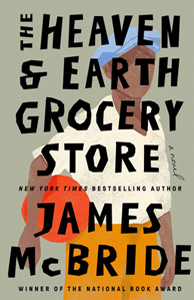 |
"The new novel from the bestselling, National Book Award-winning, Oprah Book Club-picked, Barack Obama favourite James McBride. In 1972, when workers in Pottstown, Pennsylvania, were digging the foundations for a new development, the last thing they expected to find was a skeleton at the bottom of a well. Who the skeleton was and how it got there were two of the long-held secrets kept by the residents of Chicken Hill, the dilapidated neighbourhood where immigrant Jews and African Americans lived side by side and shared ambitions and sorrows. As these characters' stories overlap and deepen, it becomes clear how much the people who live on the margins struggle and what they must do to survive. When the truth is finally revealed about what happened on Chicken Hill and the part the town's white establishment played in it, McBride shows us that even in dark times, it is love and community-heaven and earth-that sustain us." from Good Reads |
||
 |
"Noa Tishby is on a mission to correct misperceptions of Israel — its history, culture, and people. After watching Israel be criticized by the global community, particularly online, the Israeli actress, writer, and producer began defending the country on Twitter and beyond. What began as a hobby developed into a deep passion, and ultimately, a vocation. The more Tishby sought to explain Israel to others the more she sought to learn herself. From that journey, this book was born.
|
||
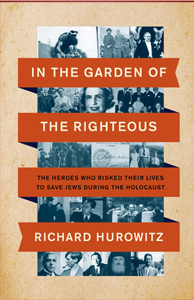 |
"Whether to obey the dictates of conscience and risk personal harm or to follow orders that would endanger others—is central to the lives of the individuals profiled in Richard Hurowitz’s “In the Garden of the Righteous: The Heroes Who Risked Their Lives to Save Jews During the Holocaust.” Mr. Hurowitz, an independent historian, chronicles 10 remarkable rescue stories, including one in which 10 British POWs banded together to save a 16-year-old concentration-camp escapee. All of these rescuers have since been honored by Israel’s Holocaust memorial, Yad Vashem, with the title Righteous Among the Nations. The most widely known of those so honored, of course, are Oskar Schindler and Raoul Wallenberg, but Mr. Hurowitz focuses instead on figures with whom most readers will be less familiar. None of them was Jewish, yet each one faced great peril to save Jews. We have much to learn from their acts of courage. What motivated them to act rather than stand by, as so many others did, in silent complicity?" from the Wall Street Journal |
||
 |
Joshua Cohen’s new novel, “The Netanyahus: An Account of a Minor and Ultimately Even Negligible Episode in the History of a Very Famous Family,” is a generational campus novel, an unyielding academic lecture, a rigorous meditation on Jewish identity, an exhaustive meditation on Jewish-American identity, a polemic on Zionism, a history lesson. It is an infuriating, frustrating, pretentious piece of work — and also absorbing, delightful, hilarious, breathtaking and the best and most relevant novel I’ve read in what feels like forever. from the NYT Click here to read the full review.
|
||
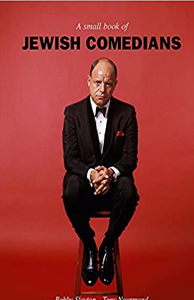 |
In 1978, Time magazine estimated that around 80 percent of professional American comics were Jewish, and Jewish humor remains a foundation stone of American popular culture and humor. This book is not intended as a definitive tome but is instead a joyful and irreverent celebration of great photography and some of the greatest one-liners of the 20th century, ripe in satire, anecdote, self-deprecation and irony. |
||
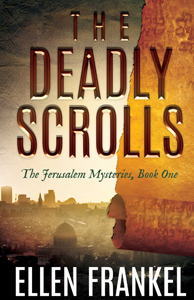 |
Set in modern Jerusalem and among the desert ruins of Qumran, this desperate hunt for an ancient treasure scroll pits a female Israeli intelligence agent against a religious fanatic hell-bent on bringing about the End of Days. An American professor’s murder reveals his discovery of a lost Dead Sea Scroll, whose text encodes the secret hiding places of the lost Second Temple Treasures. Israeli intelligence agent Maya Rimon races against time to stop a religious extremist from launching a deadly terrorist attack at the next Blood Moon, triggering the Apocalypse in the holy city of Jerusalem. The story centers around a genuine historical artifact, the so-called Copper Scroll, whose many secrets still remain undeciphered by contemporary scholars and treasure hunters. Despite decades of searching, not a single one of these invaluable treasures has ever been found. Laced with clever spycraft, encrypted electronic files, mysterious ancient puzzles, plastique explosives, car chases, and Sherlockian ratiocination, The Deadly Scrolls explores the timely theme of fanaticism: among Christian millennialists, Jewish messianists, Islamic terrorists, Israeli politicians, Orthodox Jews, conspiracy theorists, devout Zionists—and spies. In other words, it’s a Jewish Da Vinci Code! from Amazon.com |
||
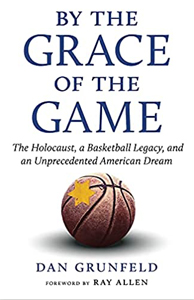 |
"When Lily and Alex entered a packed gymnasium in Queens, New York in 1972, they barely recognized their son. The boy who escaped to America with them, who was bullied as he struggled to learn English and cope with family tragedy, was now a young man who had discovered and secretly honed his basketball talent on the outdoor courts of New York City. That young man was Ernie Grunfeld, who would go on to win an Olympic gold medal and reach previously unimaginable heights as an NBA player and executive. In By the Grace of the Game, Dan Grunfeld, once a basketball standout himself at Stanford University, shares the remarkable story of his family, a delicately interwoven narrative that doesn't lack in heartbreak yet remains as deeply nourishing as his grandmother's Hungarian cooking, so lovingly described. The true improbability of the saga lies in the discovery of a game that unknowingly held the power to heal wounds, build bridges, and tie together a fractured Jewish family. If the magnitude of an American dream is measured by the intensity of the nightmare that came before and the heights of the triumph achieved after, then By the Grace of the Game recounts an American dream story of unprecedented scale. From the grips of the Nazis to the top of the Olympic podium, from the cheap seats to center stage at Madison Square Garden, from yellow stars to silver spoons, this complex tale traverses the spectrum of the human experience to detail how perseverance, love, and legacy can survive through generations, carried on the shoulders of a simple and beautiful game." from Amazon.com |
||
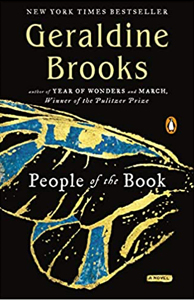 |
"The bestselling novel that follows a rare manuscript through centuries of exile and war, from the author of The Secret Chordand of March, winner of the Pulitzer Prize. Inspired by a true story, People of the Book is a novel of sweeping historical grandeur and intimate emotional intensity by an acclaimed and beloved author. Called “a tour de force” by the San Francisco Chronicle, this ambitious, electrifying work traces the harrowing journey of the famed Sarajevo Haggadah, a beautifully illuminated Hebrew manuscript created in fifteenth-century Spain. When it falls to Hanna Heath, an Australian rare-book expert, to conserve this priceless work, the series of tiny artifacts she discovers in its ancient binding—an insect wing fragment, wine stains, salt crystals, a white hair—only begin to unlock its deep mysteries and unexpectedly plunges Hanna into the intrigues of fine art forgers and ultranationalist fanatics." from Amazon.com |
||
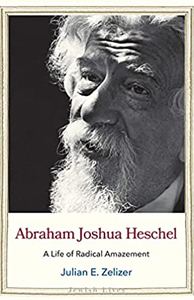 |
A biography of the rabbi Abraham Joshua Heschel, who became a symbol of the marriage between religion and social justice
|
||
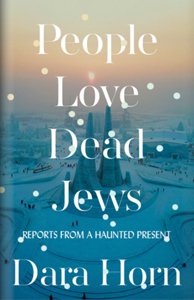 |
"A startling and profound exploration of how Jewish history is exploited to comfort the living. Renowned and beloved as a prizewinning novelist, Dara Horn has also been publishing penetrating essays since she was a teenager. Often asked by major publications to write on subjects related to Jewish culture—and increasingly in response to a recent wave of deadly antisemitic attacks—Horn was troubled to realize what all of these assignments had in common: she was being asked to write about dead Jews, never about living ones. In these essays, Horn reflects on subjects as far-flung as the international veneration of Anne Frank, the mythology that Jewish family names were changed at Ellis Island, the blockbuster traveling exhibition Auschwitz, the marketing of the Jewish history of Harbin, China, and the little-known life of the "righteous Gentile" Varian Fry. Throughout, she challenges us to confront the reasons why there might be so much fascination with Jewish deaths, and so little respect for Jewish lives unfolding in the present. Horn draws upon her travels, her research, and also her own family life—trying to explain Shakespeare’s Shylock to a curious ten-year-old, her anger when swastikas are drawn on desks in her children’s school, the profound perspective offered by traditional religious practice and study—to assert the vitality, complexity, and depth of Jewish life against an antisemitism that, far from being disarmed by the mantra of "Never forget," is on the rise. As Horn explores the (not so) shocking attacks on the American Jewish community in recent years, she reveals the subtler dehumanization built into the public piety that surrounds the Jewish past—making the radical argument that the benign reverence we give to past horrors is itself a profound affront to human dignity." from Amazon |
||
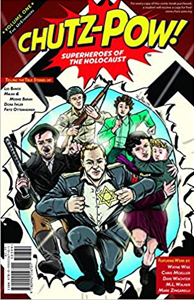
Click here to read about Chutz-Pow at the website of The Holocaust Center of Pittsburgh |
CHUTZ-POW! SUPERHEROES OF THE HOLOCAUST is an acclaimed and ongoing comic-book series created and published by The Holocaust Center of Pittsburgh that seeks, as its mission, to place stories of UpStanders’ courage, resilience, and sacrifice at the forefront of Holocaust awareness. Each volume is an anthology by award-winning creative collaborators, telling true-life stories of heroic survivors who brought light into some of the darkest recesses of World War II. Created for both general and scholastic audiences ages 12 and up, CHUTZ-POW! unravels the larger narrative of the Holocaust with thematic volumes that explore the documented micro-histories of its profiled subjects. With vivid, historically-accurate art and stirring fact-based writing, these are stories that defy the expectations of conventional superhero comic books. VOLUME ONE: THE UPSTANDERS introduces readers to five survivors who each used various forms of resistance to defy the Nazis before eventually relocating to Pittsburgh; VOLUME TWO: INTERNATIONAL HEROES tells the dramatic stories of other, more globally well-known figures. VOLUME THREE: THE YOUNG SURVIVORS, released in February 2018, focuses on the stories of survivors who were children during the Holocaust. The Holocaust Center has also created The CHUTZ-POW! Teacher’s Resource Guide which provides well-researched supplemental material to fully assist educators in utilizing the series in academic settings. The guide includes a timeline of related events, background information on the subjects and locations, a glossary of terms, lesson plans, other suggested reading, and more. CHUTZ-POW! is far more than a comic-book: it’s a living testimony of perseverance and bravery created to directly connect contemporary audiences with some of the most important moral lessons of history. “When you’re acting as a superman, you’re teaching your children to be supermen.” – Fritz Ottenheimer, UpStander |
||
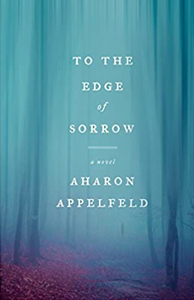 |
The Israeli novelist Aharon Appelfeld, who died in 2018 at the age of 85, was 9 years old when he escaped a certain fate in the concentration camps by hiding in the Ukraine forests, where he survived for three years before enlisting in the Red Army and, soon after, emigrating to Palestine. As one would expect, these early experiences formed the backbone of nearly all of his 40-plus books. What comes as a surprise, however, is the imaginative freedom Appelfeld allowed himself to shape and transform the cold facts of the past, a seeming transgression of the autobiographical, documentary style we tend to associate with survivor fiction. From Sam Sacks at the WSJ 5/8/20 |
||
 |
"On October 27, 2018, eleven Jews were gunned down as they prayed at their synagogue in Pittsburgh. It was the deadliest attack on Jews in American history. For most Americans, the massacre at Tree of Life, the synagogue where Bari Weiss became a bat mitzvah, came as a total shock. But anti-Semitism is the oldest hatred, commonplace across the Middle East and on the rise for years in Europe. So that terrible morning in Pittsburgh raised a question Americans can no longer avoid: Could it happen here? This book is Weiss’s answer. Like many, Weiss long believed this country could escape the rising tide of anti-Semitism. But now the luckiest Jews in history are beginning to face a three-headed dragon known all too well to Jews of other times and places: the physical fear of violent assault, the moral fear of ideological vilification, and the political fear of resurgent fascism and populism. No longer the exclusive province of the far right, the far left, and assorted religious bigots, anti-Semitism now finds a home in identity politics and the reaction against identity politics, in the renewal of America First isolationism and the rise of one-world socialism, and in the spread of Islamist ideas into unlikely places. A hatred that was, until recently, reliably taboo, anti-Semitism is migrating toward the mainstream, amplified by social media and a culture of conspiracy that threatens us all. Weiss’s cri de coeur is an unnerving reminder that Jews must never lose their hard-won instinct for danger, and a powerful case for renewing Jewish and American values in uncertain times from one of our most provocative writers. Not just for the sake of America’s Jews, but for the sake of America." From the publisher on the Jewish Book Council website. |
||
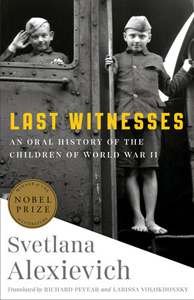 |
"His childhood ended in June 1941, when the Luftwaffe bombed Belarus. “We left the city on foot,” recalls Volodia Korshuk, who was 7 when Germany attacked his hometown of Brest, on the border with Poland. “Before my eyes a stone house ahead of us fell to pieces and a telephone flew out of a window. In the middle of the street stood a bed; on it lay a dead little girl under a blanket.” Mr. Korshuk is among the 100 survivors interviewed by Svetlana Alexievich for “Last Witnesses: An Oral History of the Children of World War II.” It’s a technique Ms. Alexievich, a winner of the Nobel Prize in literature, has used to great effect in her previous books, bringing to life the dramatic events of Soviet history through ordinary people’s voices. “In my books these people tell their own, little histories,” Ms. Alexievich has said, “and big history is told along the way.” In Ms. Alexievich’s books, such as “Zinky Boys” (1989), about the Soviet-Afghan war, and “Voices From Chernobyl” (1997), eyewitnesses speak alone; the author is silent. Stories of humanity and compassion, revealed in inhumane circumstances, are among the most moving in the book. Genia Zavoiner was 7 when a Belarusian woman rescued her from a Jewish ghetto. This woman risked her own life and those of her four children to hide a Jewish child in their home." review from the Wall Street Journal. |
||
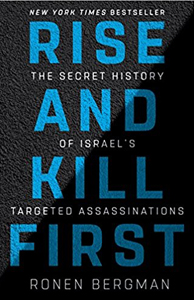 |
"A reader might begin a 750-page history of killing committed by Israel’s intelligence services with some trepidation; the tightrope is high, and it’s shaky. Much of the truth is classified — and much of it is in dispute. The moral quandaries are, to put it mildly, enormous. Ronen Bergman knows this. And from the looks of “Rise and Kill First,” he knows more than he’s supposed to. Still, Bergman, a journalist based in Israel, managed to conduct a thousand interviews along the chain of command, from political leaders to intelligence operatives. For a subject as contentious and bloody as this one, he leads with some numbers and a brute fact: “Since World War II, Israel has assassinated more people than any other country in the Western world.” What follows is an exceptional work, a humane book about an incendiary subject. Blending history and investigative reporting, Bergman never loses sight of the ethical questions that arise when a state, founded as a refuge for a stateless people who were targets of a genocide, decides it needs to kill in order to survive." |
||
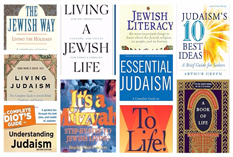 |
Ten Great Introduction to Judaism Books |
||
 |
Some humor for the new year. Click here to read the review from The Economist. |
||
Happy National Read a Book Day! |
|||
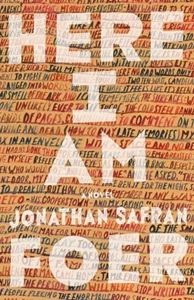 |
“Here I Am” is Mr. Foer’s first novel in 11 years, and it’s its own kind of buffet. It’s a divorce novel and a state-of-the-Jewish-soul novel and running below it, like a headline news ticker, is a plausible dystopian nightmare. An earthquake has flattened Israel, and the Arab world seizes this moment to unite and attempt to crush it. This is a big spread, in other words, an ambitious platter of intellection and emotion. Its observations are crisp; its intimations of doom resonate; its jokes are funny. “Here I Am” consistently lit up my pleasure centers. Like Kedem kosher grape juice, it is also very sweet, in ways that later made me a bit ill." |
||
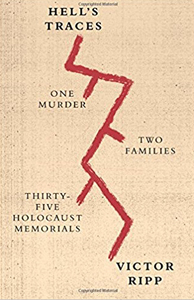 |
"How to make sense of a senseless act—this has been one of the primary driving forces in attempts to understand the Holocaust. Victor Ripp, the talented writer who takes up this question in Hell’s Traces, applies his ingenuity and investigative skills to trying to uncover the reasons behind the murder of his three-year-old cousin, Alexandre, torn from his home in Paris in July 1942 and gassed at Auschwitz. Ripp starts by putting the young boy into the context of his own family history of loss, suffering, and exile. On his father’s side, ten relatives perished, while on his mother’s side, all escaped the Nazis by fleeing. Why were these two paths so divergent? How might the differences be reconciled? To Ripp, the Holocaust is not long-ago history, but rather a series of events that were experienced directly. In order to better understand them, and to try to give order and sense to the chaos and trauma, he studied and visited Holocaust memorial sites throughout Europe. Although he made pilgrimages to six countries and went to a total of 35 memorials—each one singular and moving—he struggled to create a coherent picture of what happened in the Holocaust, and why." |
||
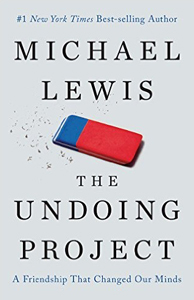 |
"Michael Lewis’s brilliant book celebrates Daniel Kahneman and Amos Tversky, Israeli-American psychologists who are our age’s apostles of doubt about human reason. The timing is fortunate, given that overconfident experts may have caused and then failed to predict such momentous events as Brexit and the election of Donald Trump. "Kahneman and Tversky are no longer obscure figures, thanks in part to Kahneman’s best-selling “Thinking, Fast and Slow.” Yet their story is still not well known. They were both grandsons of rabbis from Eastern Europe, and both atheists. They were deeply affected by their service in the Israeli military — including in the 1973 Yom Kippur War, after they had already established themselves as academics. The experiences helped make Kahneman far more practical than he otherwise might have been, because he understood that psychology could save, or cost, lives." From the New York Times. |
||
| The 26 books we will be reading in 2017 from The Forward | |||
| Victim and Perpetrator, The Nemirovsky Question | |||
|
"Michael Chabon’s new book is described on the title page as “a novel,” in an author’s note as a “memoir” and in the acknowledgments as a “pack of lies.” This is neither as confusing nor as devious as it might sound, since “Moonglow” is less a self-conscious postmodern high-wire act than an easygoing hybrid of forms. Chabon has what sounds like a mostly true story to tell — about characters whose only names are “my grandmother” and “my grandfather,” and also about mental illness, snake hunting, the Holocaust and rocket science — and he may not have wanted to be bound too tightly by the constraints of literal accuracy in telling it. At the same time, he has shaken loose the formal conventions of fiction, liberating himself in particular from the tyranny of plot. In his previous books, Chabon has always shown great skill at operating the novelistic machinery of cause and effect, foreshadowing and surprise, especially in semi-fabulist confections like “The Amazing Adventures of Kavalier & Clay” and “The Yiddish Policemen’s Union.” But in more realistic books the humming of those narrative engines can sometimes drown out the interesting cacophony of life. For me, that was the case in “Telegraph Avenue,” a well-observed slice of gentrifying urban life clogged with a bit too much Dickensian contrivance to work as well as it should have. “Moonglow,” in happy contrast, wanders where it will, framing a series of chronologically disordered episodes from the past with conversations involving the narrator (who never tries to persuade us that he is anyone other than Michael Chabon) and various kinfolk, principally his mother and grandfather. This isn’t to say that the book lacks structure, but rather that its structure is determined by the logic of memory, and that the author has resisted the urge to do too much tidying and streamlining. The action zigzags across time and geography — from Germany in the last days of World War II through a grab bag of American locations in the decades after — with blithe indifference to the usual rules of linearity or narrative economy. A sensational and tragic revelation that might have been at the volcanic center of a more familiar kind of book is disclosed almost in passing. There are moments at which you can feel the irresistible temptation to embellish and invent, to infuse reality with Chabonesque touches of wistful Jewish magic realism, being resisted." From NY Times book review. |
||
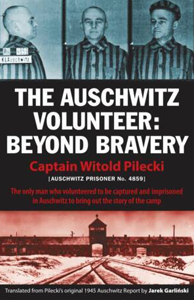 |
"One man volunteered for Auschwitz, and now we have his story. In September 1940 the 39-year-old Polish cavalry officer Witold Pilecki deliberately walked into a German roundup in Warsaw, and was sent by train to the new German camp. His astounding choice was made within, and for, Poland’s anti-Nazi underground. Poland had been destroyed a year earlier by its two powerful neighbors: eastern Poland had been annexed by the Soviet Union; the western half, including Warsaw, was taken by Nazi Germany. The Soviets overwhelmed Polish attempts at resistance in their zone, but under the Germans, officers like Pilecki managed to establish confidential networks that would come to be known as the Underground State and the Home Army. Auschwitz was set up to render Polish opposition to German rule impossible, and the first transport from Warsaw, in August 1940, had included two of Pilecki’s comrades. He went to Auschwitz to discover what had become of them, and what the camp meant for Poland and the world. This he learned and conveyed. Pilecki’s report on Auschwitz, unpublishable for decades in Communist Poland and now translated into English under the title “The Auschwitz Volunteer,” is a historical document of the greatest importance." Read the complete review from the NY Times. |
||
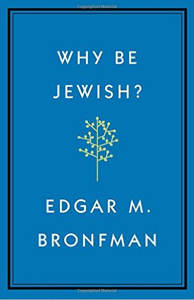 |
"Edgar M. Bronfman's clarion call to a generation of secular, disaffected, and unaffiliated Jews, this book addresses the most critical question confronting Judaism worldwide. Completed in December 2013, just weeks before he passed away, WHY BE JEWISH? expresses Edgar Bronfman's awe, respect, and deep love for his faith and heritage. Bronfman walks readers through the major tenets and ideas in Jewish life, fleshing out their meaning and offering proof texts from the Jewish tradition gleaned over his many years of study with some of the greatest teachers in the Jewish world. With honesty, poignancy, and passion, Bronfman shares In WHY BE JEWISH? insights gleaned from his own personal journey and makes a compelling case for the meaning and transcendence of a secular Judaism that is still steeped in deep moral values, authentic Jewish texts, and a focus on deed over creed or dogma." From Amazon.com |
||
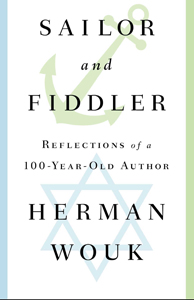 |
"To this company of long-lived legends, one should add novelist Herman Wouk (born in 1915). In “Sailor and Fiddler,” he offers a “reminiscent glance” at both his writing career (the “Sailor”) and his Jewish spiritual journey (the “Fiddler”). The little book’s prose is strong and clear, and Wouk comes across as still a fairly lively fellow. Apart from the shattering death of his first son at the age of 5, he’s also led an enviable life. In his 20s, he spent five years as a gagman for the great radio comic Fred Allen, a period he sums up as “a long dream in a feather bed.” During the Second World War, he served in the Pacific onboard a minesweeper, which provided him with material for his great “crazy captain book,” “The Caine Mutiny.” It received the 1952 Pulitzer Prize for fiction and was later transformed into a celebrated play and movie." From the Washington Post. Click here to read the complete review. | ||
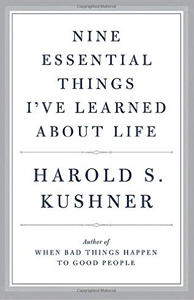 |
"The author of the international mega-best-seller “When Bad Things Happen to Good People” and a dozen other books on faith has spent much of his 55 years in the rabbinate trying to give people a different idea of God than the all-powerful and all-knowing bearded man in the sky. But, he admits, crediting Maimonides for the idea, even if we decide God is not a being, our human imagination is so limited, we can only conceive of God as a being. For this Conservative rabbi, the best question isn’t, “Where’s God?” but, “When is God?” The second question urges readers to look for God not in places but in moments. In fact, his favorite line in his new book, “Nine Essential Things I’ve Learned About Life” (Knopf), is his recounting of his response to a CNN interviewer, after an experiment showed that being prayed for doesn’t help sick people heal. “It isn’t God’s job to make sick people healthy. That’s the doctor’s job. God’s job is to make sick people brave, and in my experience, that’s something God does really well.”" |
||
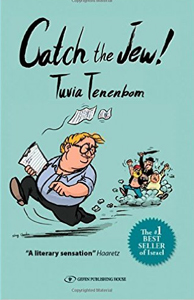 |
"Here is the classic recipe for writing about Israelis and Palestinians: start by mentioning the “cycle of violence” and the distrust it has bred between two peoples in a contested holy land. Next speak of the sane moderates on both sides who are willing to compromise and believe in what “everyone” knows to be the reasonable way forward, a two-state solution. Bemoan how “extremists” on the side you dislike are sabotaging prospects for peace. Repeat until the U.S. president calls for a new peace conference, then insist it represents a last chance. In “Catch the Jew!,” Tuvia Tenenbom eschews this crusty framework. Crisscrossing Israel and the Palestinian Territories over seven months in 2013-14, Mr. Tenenbom meets with high-ranking politicians, celebrated writers, religious leaders, “human rights” professionals, left-wing political activists and West Bank settlers, cajoling Jews and Arabs to speak for themselves. Mr. Tenenbom’s conversations range from the sacred to the profane, from high-level politics to ribald discussions of the dating rituals of various religious groups and ethnicities. “Catch the Jew!” is an illuminating—and alarming—account of a part of the promised land that few foreigners see." Read the complete review in the WSJ. |
||
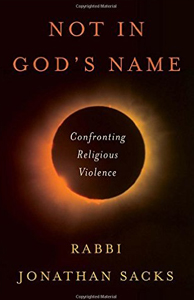 |
"From Asia to Africa, Islamic militants are slaughtering fellow Muslims. In Europe, they’re fomenting anti-Semitism. Through the Internet, they’re spreading hatred and winning recruits. We can’t defeat this enemy with weapons, money or liberal platitudes. We need a man of God. Into this role steps a most unlikely candidate: Jonathan Sacks, the former chief rabbi of Britain. Mr. Sacks believes that Islamic violence, like Jewish and Christian violence, flows from a misunderstanding of sacred text. In “Not in God’s Name,” he illuminates a wiser faith and a gentler God. It’s a perceptive, poignant and beautifully written book. But its analysis of history suggests a darker conclusion: Words alone won’t pacify Islam. There will be a lot more killing. The problem isn’t Islam: Mr. Sacks points out that Jewish and Christian scriptures have also been invoked to justify violence. It’s human nature." |
||
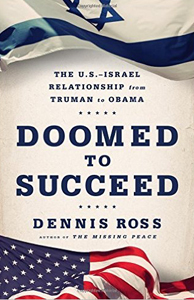 |
"Dennis Ross and “Middle East Peace Process” are nearly synonymous, and Mr. Ross wrote an 800-page book on the subject, “The Missing Peace,” after serving as a Mideast envoy to President Bill Clinton. So why another volume now? In “Doomed to Succeed,” the Washington hand brings his account up to date by covering the George W. Bush and Barack Obama administrations and looking at U.S.-Israel relations from Truman on. The chapters that cover administrations in which Mr. Ross served—especially at a high level, as he did under Messrs. Bush, Clinton and Obama—are predictably the most lively. There is always the danger that familiarity breeds forgiveness, and the author is indeed less critical of mistakes under Messrs. Clinton or Bush than others might be. But that grant of clemency is withdrawn toward Mr. Obama, as Mr. Ross’s familiarity breeds page after page of criticism." |
||
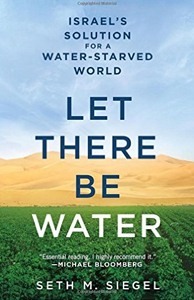 |
"One of the few places where we might look for solutions is a country with seemingly insurmountable water problems: Israel. Since its founding in 1948, Israel, which is 60% desert, has become a water superpower. This is the unlikely story recounted by Seth M. Siegel in his insightful “Let There Be Water.” He argues that Israel’s example of making the desert bloom through a mixture of grit, smart regulation, technology and free-market incentives can offer a model for the rest of the world. Jewish inventiveness was born of political necessity. In the 1930s, most of the water in what was then known as Palestine came from shallow wells, and the infrastructure didn’t exist to connect the country’s disparate regions, which have wildly varying climates. There was water in the far north, but the Jewish population was concentrated around Tel Aviv, in the middle of the country. In the south lay the Negev Desert, which appeared “inhospitable to human habitation, a wasteland,” Mr. Siegel writes. British colonial officials believed that Palestine could hold no more than two million people without going thirsty—there are now more than 12 million Jews and Arabs between the Jordan River and the Mediterranean Sea—and the British White Paper of 1939 sought “to choke off Jewish immigration to Palestine” by limiting the number of new arrivals and claiming that the land simply could not support more inhabitants." From the WSJ. |
||
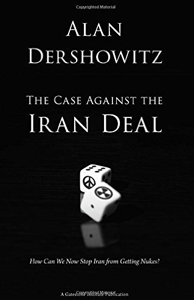 |
"The greatest danger the world faces in the twenty-first century is an Iranian nuclear arsenal. That is why decisions regarding Iran’s nuclear program may be the most important of our time. The negotiations that led to this bad deal were deeply flawed. But it doesn’t follow that the deal should be rejected by Congress. If the President is right that rejecting this deal will be worse than accepting, then he has put us in the terrible position of choosing between bad and worse. In The Case Against the Iran Deal: How Can We Stop Iran From Getting Nukes?, Harvard Law Professor Emeritus Alan Dershowitz evaluates the pros and cons of the Iran nuclear agreement. He asks the fundamental questions about what the deal means, how it will be implemented, and whether we now have the capacity to stop Iran from developing nuclear weapons. As a lawyer with dec ades of negotiation experience, and a regular commentator on Middle Eastern politics, Dershowitz explains how we could have gotten a better deal, and offers a unique analysis of the Obama administration's negotiations with Iran and the implications of a deal for Israel, the Middle East, and the global community. It is a call for both intelligent reflection and for determined action to stop Iran from getting the bomb." From Amazon.com, click here to read more. |
||
 |
"A brave thing to do in mainstream journalism (“brave” being a relative concept here) is to publicly confess your faith in God, or to identify with a specific religious tradition in a sincere and enthusiastic manner. There are notable exceptions to this rule, but generally speaking, American journalists, Coastal Elite Division, prefer individuality, deep skepticism, impiety, and sometimes even cynicism, to genuine expressions of faith. (Skepticism and piety can, of course, coexist in the same person, as you will see if you read on. )The title of his book comes from a question once put to Gregory, an ex-White House correspondent for NBC, by his sometime-adversary, George W. Bush, who was, of course, entirely comfortable discussing his faith in the open. This book is proof that Gregory is more at ease with the question than almost anyone I know in Washington journalism. He is, however, not entirely at ease with his answers, which is part of what makes How’s Your Faith? so interesting. What makes this book particularly compelling to me is the way in which he wrestles with the demands of Judaism, and with the limitations of a sometimes-spiritually stunted (my words, not his) non-Orthodox American Jewish community; and with the challenges of living with a spouse who both wants to honor her own Christian faith and also raise their children as Jews. (Gregory’s wife, Beth Wilkinson, is in many ways the most interesting character in this book.)" From the Atlantic, click here to read the full review. |
||
 |
"By 1947 the British, who had ruled mandatory Palestine since 1917, lost the will to remain. Their exhaustion was the catalyst for the 1947-48 war and the establishment of Israel. As Sir Alan Cunningham, the British High Commissioner, told the head of Jewish settlement, David Ben-Gurion, who would go on to become Israel’s first prime minister: “The British people are bloody fed up with the whole mess.” After two costly wars, the disappointments of the misnamed Arab Spring, and the ever-worsening situation in Iraq, Syria, Libya and Yemen, Americans can be forgiven for flirting with a similar sentiment today. No doubt some of the support for the feckless Iran deal stems from fatigue at the prospect of confronting another enemy in a region that seems to confound us. In “The Tail Wags the Dog,” Efraim Karsh cautions against a total mental and literal withdrawal from the Middle East. Yet the author, a longtime professor at King’s College London now teaching in Israel, does propose a certain strategic humility: “Just as no foreign surgeon could have saved the ‘Sick Man of Europe’ (as the Ottoman Empire was famously known) unless he helped himself, so no ‘only remaining superpower’ can fix the Middle East’s endemic malaise,” he writes." Click here to read the complete review in the Wall Street Journal. |
||
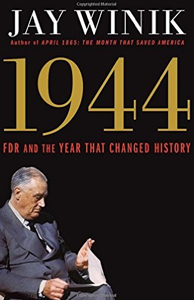 |
"Jay Winik’s “1944: FDR and the Year That Changed History” is a monocular book with a misleading title. It is not an account of World War II’s last full year, as one might expect. The war in the Pacific is mentioned only in passing. The ongoing fighting in Italy gets short shrift, too, as does the Eastern Front. Instead, nearly half of the book’s 536 pages of narrative are given over to the Nazi assault on European Jewry, the Roosevelt administration’s reaction to it, and what the author believes to be the president’s inexcusable failure to bomb the death camp at Auschwitz. Mr. Winik is a vivid storyteller. His harrowing account of the escape of Rudolf Vrba and Fred Wetzler, two Auschwitz inmates who were determined to tell the world of the horrors they had witnessed, is especially memorable. But he too often overdoes things. FDR wasn’t “bowlegged” before polio felled him. Nor did he “overcome” that disease; he simply did not let it overcome him. His body didn’t “convulse” at the news of Pearl Harbor; his wife remembered that he was “completely calm, almost like an iceberg.” Many American diplomats were blindly bureaucratic when dealing with refugees from Hitler—and some were openly anti-Semitic—but it’s overkill to caricature them all as “immaculate in their striped trousers, wing collars, and pince-nez.” Click to read the full review at the Wall Street Journal. or the Boston Globe. |
||
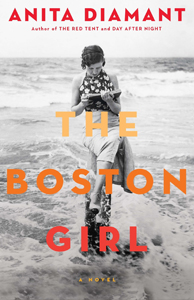 |
"Anita Diamant’s new novel,“The Boston Girl,” comes to us as the transcript of a tape-recorded monologue delivered by an 85-year-old woman named Addie Baum. Addie is cheery, alert and full of needlepointed wisdom. If this allegedly spontaneous memoir is any indication, she’s also the most well-organized 85-year-old woman in the world. Asked by her granddaughter to talk about how she got to be the person she is today, Addie takes us back to 1900, the year she was born. From there, she leads us through a series of episodes that have all the color and vibrancy of a plastic bouquet. Addie was the plucky daughter of immigrants who escaped starvation and violence in Russia to settle in a tiny Boston apartment. “In 1915, there were four of us living in one room,” she begins. “We had a stove, a table, a few chairs, and a saggy couch that Mameh and Papa slept on at night.”They eat a lot of potatoes and cabbage. Deeply suspicious of America’s loose culture, at home Addie’s parents speak only Yiddish, mostly to bicker. Her mother, in particular, is a joyless hag. She criticizes Addie for wasting her time studying and staying in school: “She’s already ruining her eyes from reading. No one wants to marry a girl with a squint.” That’s Mameh in a nutshell, which is where she stays throughout this novel, huddled and bitter, tossing off worn aphorisms and barbs about everyone else’s failures. (Does Mameh turn sweet and loving on her deathbed? Such is the suspense that electrifies “The Boston Girl.”)" Read more from the Washington Post. |
||
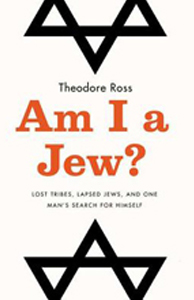 |
"Theodore Ross is the features editor at Men’s Journal and a former associate editor at Harper’s Magazine. When he was nine years old, his mother moved him and his brother from New York to Mississippi and attempted to erase all traces of the family’s Judaism, identifying them as Unitarians to their new neighbors. Ross wrote about the experience in a 2009 Harper’s essay titled “Shalom on the Range.” In his just-published book, Am I a Jew?, he tracks the history and evolution of American Judaism, detailing his efforts to reconcile with his childhood alienation from his heritage by traveling to Jewish communities across the U.S. and Israel." |
||
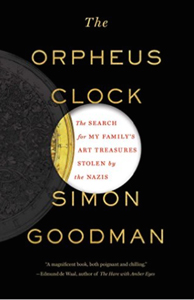 |
"The passionate, gripping, true story of one man’s single-minded quest to reclaim what the Nazis stole from his family, their beloved art collection, and to restore their legacy. Simon Goodman’s grandparents came from German-Jewish banking dynasties and perished in concentration camps. And that’s almost all he knew about them—his father rarely spoke of their family history or heritage. But when he passed away, and Simon received his father’s old papers, a story began to emerge. The Gutmanns, as they were known then, rose from a small Bohemian hamlet to become one of Germany’s most powerful banking families. They also amassed a magnificent, world-class art collection that included works by Degas, Renoir, Botticelli, Guardi, and many, many others. But the Nazi regime snatched from them everything they had worked to build: their remarkable art, their immense wealth, their prominent social standing, and their very lives." from Amazon.com Click here to read the review in the New York Post, or the Wall Street Journal. |
||
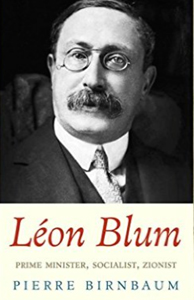 |
"Léon Blum (1872–1950), France’s prime minister three times, socialist activist, and courageous opponent of the pro-Nazi Vichy regime, profoundly altered French society. It is Blum who is responsible for France’s forty-hour week and its paid holidays, which were among the many reforms he championed as a deputy and as prime minister, while acting as a proudly visible Jew, a Zionist, and eventually a survivor of Buchenwald. Click here to read the review in the New York Times or the Wall Street Journal. |
||
 |
"New York Times bestselling author Michael B. Oren’s memoir of his time as Israel’s ambassador to the United States—a period of transformative change for America and a time of violent upheaval throughout the Middle East—provides a frank, fascinating look inside the special relationship between America and its closest ally in the region. Michael Oren served as the Israeli ambassador to the United States from 2009 to 2013. An American by birth and a historian by training, Oren arrived at his diplomatic post just as Benjamin Netanyahu, Barack Obama, and Hillary Clinton assumed office. During Oren’s tenure in office, Israel and America grappled with the Palestinian peace process, the Arab Spring, and existential threats to Israel posed by international terrorism and the Iranian nuclear program. Forged in the Truman administration, America’s alliance with Israel was subjected to enormous strains, and its future was questioned by commentators in both countries. On more than one occasion, the friendship’s very fabric seemed close to unraveling. Ally is the story of that enduring alliance—and of its divides—written from the perspective of a man who treasures his American identity while proudly serving the Jewish State he has come to call home. No one could have been better suited to strengthen bridges between the United States and Israel than Michael Oren—a man equally at home jumping out of a plane as an Israeli paratrooper and discussing Middle East history on TV’s Sunday morning political shows. In the pages of this fast-paced book, Oren interweaves the story of his personal journey with behind-the-scenes accounts of fateful meetings between President Obama and Prime Minister Netanyahu, high-stakes summits with the Palestinian leader Mahmoud Abbas, and diplomatic crises that intensified the controversy surrounding the world’s most contested strip of land. A quintessentially American story of a young man who refused to relinquish a dream—irrespective of the obstacles—and an inherently Israeli story about assuming onerous responsibilities, Ally is at once a record, a chronicle, and a confession. And it is a story about love—about someone fortunate enough to love two countries and to represent one to the other. But, above all, this memoir is a testament to an alliance that was and will remain vital for Americans, Israelis, and the world." from Amazon.com |
||
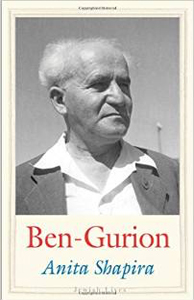 |
"In 1966, when Anita Shapira was a graduate student at Tel Aviv University, she decided to try and interview David Ben-Gurion for a research paper. She was interested in the period before Israel’s independence and wrote a letter to the country’s first prime minister, then 80. She was delighted when she got a handwritten invitation to come and see him. By then Ben-Gurion had retired from public life to a small wooden shack in Kibbutz Sdeh Boker in the Negev desert, where he wrote his memoirs and took long walks in the midday heat. He had few visitors and received Ms. Shapira warmly, ushering her into his book-lined study for a two-hour conversation. It was only after she’d arrived back home in Tel Aviv that she realized Ben-Gurion had answered none of her questions. Ms. Shapira recalls this encounter at the beginning of her keenly observed biography of Ben-Gurion, and it serves as a perfect framing device for the book’s theme: Israel’s founding father was a very hard man to crack. On the one hand, Ben-Gurion was extremely audacious: He was willing to send young Jews into battle, as he did in the Jewish state’s war of independence, knowing that some would never return—“a decision Jews had not made,” Ms. Shapira writes, “since the Bar-Kokhva revolt in the second century.” Yet he was also extremely cautious. Unlike many of his lieutenants and most of his political foes, he advocated against unrestrained Jewish armed resistance during the decades before Israel’s independence in 1948 and favored negotiating with the British government and the United Nations for Jewish independence in Palestine. He was prophetic: “I am totally impassioned in that I feel we are on the eve of events liable to change the course of our history,” he wrote in 1937, “events that have occurred only twice or three times in our three-thousand-year history.” Yet he was also a pragmatic politician who spent much of his career canvassing for votes and taking joy in even the most minor electoral triumphs. He could lecture passionately about war and peace but was utterly lost when the occasion called for even a spot of small talk." From the WSJ. |
||
 |
"For too long, Jews have defined themselves in light of the bad things that have happened to them. And it is true that, many times in the course of history, they have been nearly decimated: when the First and Second Temples were destroyed, when the Jews were expelled from Spain, when Hitler proposed his Final Solution. Astoundingly, the Jewish people have survived catastrophe after catastrophe and remained a thriving and vibrant community. The question Rabbi Jonathan Sacks asks is, quite simply: How? How, in the face of such adversity, has Judaism remained and flourished, making a mark on human history out of all proportion to its numbers? Written originally as a wedding gift to his son and daughter-in-law, A Letter in the Scroll is Rabbi Sacks's personal answer to that question, a testimony to the enduring strength of his religion. Tracing the revolutionary series of philosophical and theological ideas that Judaism created -- from covenant to sabbath to formal education -- and showing us how they remain compellingly relevant in our time, Sacks portrays Jewish identity as an honor as well as a duty." From Amazon.com |
||
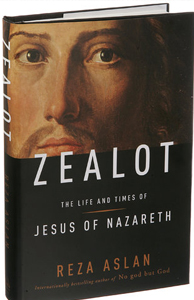 |
Jesus the loving shepherd. Bringer of peace and justice. Teacher of universal morals. Jesus the rabbi. Jesus the philosopher. Jesus the apocalyptic prophet. Jesus the Christ of faith. People have constructed many different Jesuses. For at least two centuries, scholars and popular writers have mined the Christian Gospels to “look behind” them, to create a portrait of Jesus, using purely modern methods: the historical Jesus as opposed to the Christ of faith. In his book “Zealot: The Life and Times of Jesus of Nazareth,” Reza Aslan follows this long tradition, settling on the hypothesis, also around for hundreds of years, that Jesus was a Jewish zealot, a rebel against Rome and the Romans’ local agents. Mr. Aslan’s book has been greeted with unwarranted controversy. Some conservatives seem offended by merely the idea that a Muslim scholar would write a book about Jesus. This should be no more controversial than a Christian scholar’s writing a book about Islam or Muhammad. It happens all the time. Nor is Mr. Aslan’s thesis controversial, at least among scholars of early Christianity. |
||
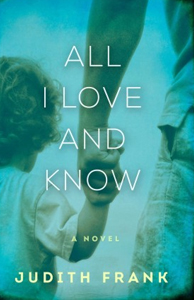 |
You don’t have to be Jewish to enjoy “All I Love and Know,” Judith Frank’s terrific new novel. Nor do you have to be gay. Although the book addresses issues important to both Jews and gays — Jewish identity, the Israeli-Palestinian conflict, gay parenting and marriage equality — it will satisfy anyone who longs for a first rate novel. Daniel Rosen is a twin whose brother and sister-in-law are killed when a terrorist bomb explodes in an Israeli café. Their will grants custody of their baby boy and 6-year-old daughter to Daniel and his partner Matt, who, until then, have led an enviably carefree life as a popular gay couple in the “Lesbian Mecca” of Northampton, Mass. Read the complete review here.
|
||
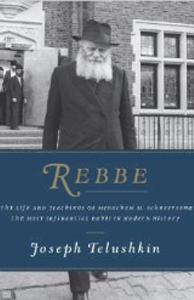 |
"Rabbi Joseph Telushkin is one of the great Jewish thinkers of our time. In addition to being a prolific author -- the Rabbi has published over 15 books running the gamut on Jewish topics, from history to ethics -- and a dynamic speaker, Rabbi Telushkin is a thoughtful scholar. I was thrilled and intrigued to see that his newest work would take on the important topic of the life of Rabbi Menachem Mendel Schneerson, the seventh Lubavitcher Rebbe. While the project could have easily succumbed to the realm of hagiography, thankfully Rabbi Telushkin's work goes beyond the usual biographical form and delivers a rich tapestry of a dynamic and complex man. And like a tapestry, there are many threads in this book, all of which lend themselves to a story worth telling." Click here to read the complete review from the Hufffington Post. | ||
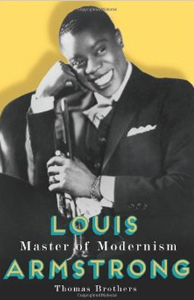 |
“Louis Armstrong, Master of Modernism” by Thomas Brothers is a tribute to an unsurpassed jazz trumpeter and singer who relished Yiddishkeit. Born in 1901, Armstrong performed and recorded nearly until his death in 1971. Grateful early on for the respect, encouragement and affection he received as a boy from the Karnofskys, a Lithuanian Jewish family in his hometown of New Orleans, he later became dependent for decades on his manager Joe Glaser, a Jew with mob ties. Toward the end of his life, he repeatedly jotted down thanks to Jewish doctors who prolonged his career. At home, Armstrong snacked on matzoh as a preferred treat and wore a Star of David (accounts differ over whether it was given to him by the Karnofskys or by Glaser). The jazz photographer Herb Snitzer, who captured an image of Armstrong on a bus in 1960 with the Star of David clearly visible, commented: “[Armstrong] wore the Star his entire life.” |
||
 |
In “The Eternal Nazi,” journalists Nicholas Kulish and Souad Mekhennet tell the gripping story of the decades-long pursuit of Nazi doctor Aribert Heim and, in the process, offer a larger history of postwar Germany’s attempts to come to terms with its violent past. Dr. Aribert Heim — notorious for the brutal medical experiments he performed at Mauthausen concentration camp — spent the last 30 years of his life as a fugitive from justice in Egypt. Authorities pursued his trail 16 years after his death, until Kulish and Mekhennet, on assignment for the New York Times (where Kulish was Berlin bureau chief from 2007 to 2013), uncovered definitive proof of his fate. Clocking in at just 250 action-packed pages, “The Eternal Nazi” is a brisk, compelling read, with all the frustrating plot twists and eccentric character cameos of an espionage thriller. Clocking in at just 250 action-packed pages, “The Eternal Nazi” is a brisk, compelling read, with all the frustrating plot twists and eccentric character cameos of an espionage thriller. Chapters alternate between accounts of Heim’s life in hiding (and the constantly foiled attempts to pursue him) and larger historical accounts of postwar Germany and the nation’s by-no-means inevitable progression from self-willed oblivion to a state of painful reckoning with its violent past. All along the way, Kulish and Mekhennet share vignettes about everyday Germans confronting their own past, and about the tension within the country between “collective guilt, which is easier to accept, and individual responsibility.” Click here to read more.
|
||
 |
"Section 34, Row 11, Plot No. 4 of the Lukianovka Cemetery, in the northern suburbs of Kiev, is the grave of a boy named Andrei Yushchinsky who was brutally murdered 103 years ago, his body, with 47 puncture wounds in it, found by some playmates in a cave. Yushchinsky’s grave had lain neglected for almost a century, until, about a decade ago, some 15 men dressed in old tsarist officers’ uniforms appeared and spruced it up, laying new shrubbery and affixing inscriptions on the gravestone. One of the inscriptions identified young Yushchinsky, who was most likely murdered by a small-time Russian criminal gang, as a “saintly boy-martyr,” the word “martyr” suggesting that the boy died for his Christian faith. The other inscription got more directly to the point: “Andrei Yushchinsky, martyred by the Yids in 1911.” The conviction that he was, one of the innumerable disproven ideas that remain attached to at least a few stubborn minds, would seem to be the main point of The Devil That Never Dies." |
||
 |
Ari Shavit wants to do nothing less than prompt a fresh discourse on Israel, something free and loving, critical and authentic, a conversation that accepts both the miracle and the true consequences of the Jewish state, one that will bring American Jews closer to the real Israel and Israelis closer to their own lost narrative. |
||
 |
"Alisa Solomon’s look at “Fiddler on the Roof” explores not only the making of the musical, but also the way the show reflects evolving Jewish cultural identity in America and around the world. It’s about how gentiles see Jews and about how Jews see themselves. It’s about a particular moment in American history when identity politics, feminism, generational rifts, ethnic pride, concerns about authenticity and an interest in immigration history came together in a rich cholent. It’s about a particular time in Broadway history when the musical was changing from something stagy and stilted to something more musically and formally challenging. Oh, and it’s about “Fiddler” productions across cultures and time periods, and “Fiddler” in pop culture — from “The Simpsons” to an ultra-Orthodox novel that “reads like a kosher version of the evangelical Christian ‘Left Behind’ series” to the Amazing Bottle Dancers (a troupe of fake Hasidim for hire at bar mitzvahs, doing Jerome Robbins’s astounding wedding dance choreography with paste-on payes, hats with holes cut into them and shatterproof bottles on their heads). Vey iz mir." |
||
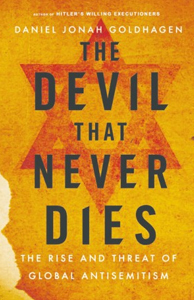 |
"Daniel Jonah Goldhagen’s first book, “Hitler’s Willing Executioners” (1996), was a blockbuster despite (or because of) its blunt thesis: Inspired by a uniquely German “eliminationist Anti-Semitism” inherited from the Middle Ages, ordinary Germans killed millions of Jews during the Holocaust because they wanted to. The book was criticized by many historians as uninformed, simplistic, even “totally wrong.” But there was a virtue to the provocative way in which it posed its questions about individual and collective responsibility, about the power of prejudice, about the politics of hate. It called new attention to the questions themselves. “Eliminationist Anti-Semitism” is also the subject of Goldhagen’s new book, “The Devil That Never Dies,” but now the stage is fearsomely enlarged and the entire world is in its grips, with the possible exception of the United States. Goldhagen’s case is twofold. On the one hand, he offers numerous examples of individuals — from human rights advocates and French ambassadors to any number of Muslim politicians — who openly advocate the elimination of the state of Israel and, often, its people. Today it seems acceptable, even praiseworthy in many circles, to move from criticizing Israel to suggesting its disappearance." Click here to read the complete review from the Washington Post. Click here to read a review from Moment Magazine. |
||
 |
Mosheh ben Maimon (also known as Rambam or Maimoni. des), the medieval philosopher, and Solomon Schechter, the modern rabbinical scholar, are among the characters that populate Horn’s latest novel, which takes its title from Moreh Nevukhim, Maimonides’s monumental contribution to Jewish thought. Set in the present and in 1896 and 1171, “A Guide for the Perplexed” jumps back and forth between Cambridge, Mass.; Cambridge, England; Alexandria, Egypt, and Cairo. In the present, Josie Ashkenazi, a 33-year-old genius, has become rich by creating an electronic platform, Genizah, that catalogs every moment of a person’s life. While serving as a consultant at the Library of Alexandria, Josie is kidnapped and held for ransom. Imprisoned within the City of the Dead, the Cairo necropolis that is home to hundreds of thousands of paupers, she reads Maimonides’s “A Guide for the Perplexed” and ponders the philosopher’s challenge of reconciling divine omniscience with human freedom. If God knows how everything turns out, how can we presume to make a choice? |
||
 |
‘I sometimes think to myself that I’m the last of my kind.” Sparks said that Ira Levinson was based on someone extremely close to him, a Jewish man who became almost a surrogate grandfather. After Sparks’s grandparents divorced, his grandmother moved to San Diego, where she kept company with a Jewish gentleman. |
||
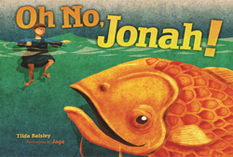
Tablet Magazine's Best Children's Books of 2012 |
 |
||
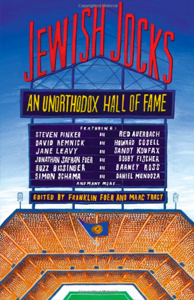 |
JEWISH JOCKS: AN UNORTHODOX HALL OF FAME is a timeless collection of biographical musings, sociological riffs about assimilation, first-person reflections, and, above all, great writing on some of the most influential and unexpected pioneers in the world of sports. Featuring work by today's preeminent writers, these essays explore significant Jewish athletes, coaches, broadcasters, trainers, and even team owners (in the finite universe of Jewish Jocks, they count!). Contributors include some of today's most celebrated writers covering a vast assortment of topics, including David Remnick on the biggest mouth in sports, Howard Cosell; Jonathan Safran Foer on the prodigious and pugnacious Bobby Fischer; Man Booker Prize-winner Howard Jacobson writing elegantly on Marty Reisman, America's greatest ping-pong player and the sport's ultimate showman. Deborah Lipstadt examines the continuing legacy of the Munich Massacre, the fortieth anniversary of which coincided with the 2012 London Olympics. Jane Leavy reveals why Sandy Koufax agreed to attend her daughter's bat mitzvah. And we learn how Don Lerman single-handedly thrust competitive eating into the public eye with three pounds of butter and 120 jalapeño peppers. These essays are supplemented by a cover design and illustrations throughout by Mark Ulriksen.
|
||
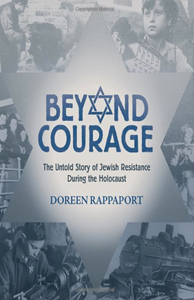 |
Beyond Courage, which is generously illustrated with period photos, maps and diagrams, includes 21 accounts—some chronicled in book form for the first time—about acts of defiance and resistance in the forests, ghettos, labor camps and concentration camps of Nazi-occupied Europe. In many of the stories, she relates how a young person takes a stand in order to save lives. Among those she writes about are Marianne Cohn, 22, a scout leader in occupied France who lost her own life, yet saved the 28 children under her care; Motele Shlayan, 12, who entertained Nazi officers with his violin, moments before setting off a bomb; Sarika Yehoshua, 17, who led an all-girl partisan force in occupied Greece; and Idel (Jack) Kagan, 14, who survived frostbite and the amputation of his toes and helped to dig a tunnel to freedom at Novogudok labor camp in Poland. Rappaport diligently searched for Kagan, even though she had no idea where he was or even if he was still alive. She ultimately found him on her 200th Google hit. He was living in London and agreed to tell his story. Rappaport has distilled an impressive amount of material to write Beyond Courage. She makes this often-painful chapter in history compelling, readable and inspirational, whether her audience consists of middle or high school students or their parents. Click here for the complete review.
|
||
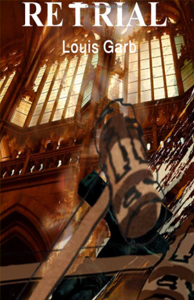 |
In “Retrial” (ISBN 1469962837) Garb tells the story of a young boy named Judah who suffers physical and emotional abuse at the hands of Billy, a fellow school-boy. The events that follow lead to a dramatic courtroom examination – a retrial of the most famous trial in history. In spite of strong opposition, young Judah and his parents go to court with the help of a family member to show how certain verses in the Gospels were the direct cause of Judah’s suffering. By critically testing the most famous trial in the world, they open up a can of worms, as lawyers and witnesses discover guilt, forgiveness, hatred and plenty of contradictions. Garb challenges the preconceptions of 2,000 years in his novel and claims that “Retrial” is one of the first fictional works to critically examine the Passion story as well as its contribution to anti-Semitism and the murder of Jews. “There is a world-wide resurgence of anti-Semitism particularly in England where the novel is set,” Garb says. “I ask my readers to open their minds and to see how the Passion story is a contributing cause.” A Bill Wallen recommendation. |
||
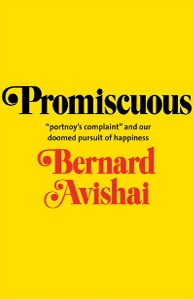 |
‘Promiscuous: ‘Portnoy’s Complaint’ and Our Doomed Pursuit of Happiness” is a very serious and very funny book about a very serious and very funny book.
What emerges from Portnoy’s adventures is, as Avishai puts it, “a way of exploring the Drang [“drive”] before the Sturm [“storm”] in a young man’s life.” All of what was wrong with Roth/ Portnoy — rage, lewdness, ingratitude — reflecting, in the eyes of many, what was wrong with much of American society, was but a part of the story. These were a small piece of what was wrong with Portnoy, and by extension, Roth. Portnoy was a person who was to be the repository of every conceivable socially unacceptable thought and action. It was all about American society — and it all came out in Roth’s book. Read the Complete review here. |
||
 |
Matt Biers-Ariel grew up in a secular Jewish family. After college he went to work on a kibbutz in Israel ("mostly to meet blond Scandinavian volunteers"). Eventually he attended a Jewish seminary, then taught at Jewish schools and wrote religious-themed books. His son Yonah proclaimed himself an atheist in kindergarten. This declaration presented something of a family dilemma when Yonah approached 13 and said he didn't want a bar mitzvah. Mr. Biers-Ariel, thinking his son should have some sort of rite of passage, suggested a father-son cross-country bicycle ride—close to 4,000 miles riding back roads from the family's home in California to the East Coast. Yonah wasn't thrilled at the idea, but it beat going to Hebrew school. "So in order to avoid a single day of chanting a small section of Torah," Mr. Biers-Ariel writes, "leading a congregation in a half-dozen prayers, and dancing with his grandmother at his bar mitzvah party, twelve-year-old Yonah Biers-Ariel, an ambivalent cyclist, decided to pedal a bicycle from San Francisco to Washington, D.C., with his dad." Then Yonah's mother and younger brother decided to tag along. "The Bar Mitzvah and the Beast" is Mr. Biers-Ariel's entertaining and occasionally poignant memoir of this road trip. ("The Beast" is the author's name for the flat-tire-prone tandem bike that he peddles with his younger son, Solomon.) To include a bit of public service, the family decides that, along the way, it will collect signatures on a petition urging Congress to curtail global warming. The author finds himself hesitating to approach a bike-shop owner listening to Rush Limbaugh on the radio. But he ends up asking for a signature, and gets it. |
||
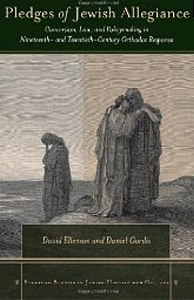 |
A firestorm erupted in the Jewish world a few years ago when the head of Israel's High Rabbinical Court issued a ruling invalidating thousands of conversions to Judaism performed under the authority of a well-known Orthodox rabbi who had been the director of the State Conversion Authority. The ruling was followed by an announcement from Israel's current chief rabbi reserving the right to revoke any conversion at any time, presumably if the sponsoring rabbi doesn't have the right pedigree or if the convert fails to live a life devoted to Jewish law. Though such a position flies in the face of long-standing precedent, which holds that conversions are not reversible, the Israeli government's decision to vest exclusive authority over matters of personal status in the hands of clerics has made Israel resemble, if only in this respect, some of its Middle Eastern neighbors. The question that lies at the heart of this controversy—"Who is a Jew?"—is not always easy to answer. Since the rabbis first codified Jewish law in the Mishna in 220 A.D., someone born to a Jewish mother has been considered a Jew. Notably, the Reform movement in the U.S. broadened the definition of a Jew to include patrilineal descent, though the other main branches of Judaism don't accept this innovation. But the rules governing traditional conversion are more complicated. There is no prescribed conversion ritual in the Bible, and the Hebrew word used to describe a person not born into Judaism (ger) is ambiguous, meaning both "convert" and "stranger." When Moses, Joseph, David and Solomon took non-Jewish wives, the wives simply joined their husbands' community. Even Ruth, the paradigmatic symbol of conversion, undergoes no formal ritual; she becomes a Jew by declaring her loyalty to Naomi: "Wherever you go, I will go. . . . Your people shall be my people; your God my God." Nor is rabbinical Judaism any clearer. Read the complete review here. |
||
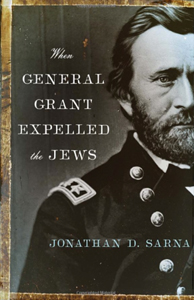 |
“An excellent study [from the] gifted and resourceful historian Jonathan D. Sarna . . . His account shines brightest around the edges of the story, offering valuable new insights into ethnic politics, press power, and the onetime ability of leaders to flip-flop with grace . . . A compelling page-turner.” “Ulysses S. Grant’s order expelling Jews from his war zone has long helped insure his eternal disgrace. Supposedly, the drunken, bloodthirsty crook was also an anti-Semite! Jonathan Sarna’s excellent, painstaking reevaluation of what really happened helps rescue Grant’s reputation; it is long overdue. It also affirms Sarna’s unsurpassed standing as a historian of American Jewry.” “Thoroughly researched and crisply written, this is a very fine work that will interest students of both American and modern Jewish history.” About the Author The PBS documentary Jewish Soldiers in Blue & Gray, which features Jonathan Sarna, explores the hidden stories of American Jews during the Civil War. |
||
 |
Recalling postwar antisemitism in London, exacerbated by tensions emanating from Mandate Palestine, Martin Fletcher focuses on the lives of refugee Jews like his parents, George and Edith (for whom he named his characters), who lived through these times and eventually became British citizens. Fletcher, who served as NBC’s News Bureau Chief in Tel Aviv for more than two decades, has researched this political thriller with the expertise of a veteran newsman, drawing from unpublished diaries and interviews. In his acknowledgements, he also thanks a former Lehi fighter “for your frank and comprehensive account of how you planned to murder Ernest Bevin,” adding, “I’m glad it was called off the night before.” Click here to read the complete review.
|
||
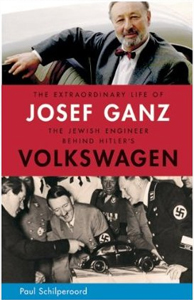 |
The true story of the Jewish engineer whose original designs for the Volkswagen (VW) Beetle were stolen by the Nazis will be published in Canada this month. “I was simply intrigued that a Jewish engineer… was behind the Volkswagen Beetle, the most successful project the Nazis ever did,” Schilperoord told the Jewish Tribune by phone from his home in Florence, Italy. More than 21.5 million VW Beetles were built over a period of 65 years. Ganz received no remuneration and no credit for his designs; even his nickname for the car, “May Bug,” was appropriated by the Nazis. The book describes how a competitor in the auto industry – first alone, then in collustion with car manufacturers, and finally with the help of high-level friends within the Nazi party – worked to destroy Josef Ganz. Read a review here.
|
||
 |
NPR Review and 30 minute audio conversation with the author "When University of Chicago professor William Dodd assumed the post of U.S. ambassador to Germany in 1933, he hoped for an undemanding position that would allow him spare time to write a book. At the time, few in the United States or Europe considered then-Chancellor Adolf Hitler a serious threat, and few expected him to remain in power long. Dodd was no exception, says Erik Larson, author of In the Garden of Beasts: Love, Terror, and an American Family in Hitler's Berlin. Having studied in Germany as a college student in the 1890s, Dodd began his term as ambassador with "a predisposition to like the Germans and to like Germany," Larson tells NPR's Jennifer Ludden. He arrived in Berlin, Larson says, with "almost a deliberate desire — deliberate objectivity, let's say — to view things as objectively as possible, without prejudging." But over the subsequent four years, the Dodd family grew uneasy as they watched Hitler consolidate his power and impose increasingly severe restrictions on Germany's Jewish population. Matters came to head as Dodd clashed with the Nazi Party and the State Department and eventually resigned over the failure of officials back home to recognize the threat the Nazis posed." from NPR
|
||
 |
Desperate for a good read prior to winter vacation, I stumbled upon Kosher Chinese at our local Barnes & Noble. Like most great finds, this book is an unexpected pleasure. This is the story of a young Jewish college graduate's two year Peace Corp stint in central China. Humerous and whimsical, Michael Levy provides a quick read of the challenges he faced in and out of the classroom while trying to teach English at a Chinese university. "Levy explores a society in flux—while mining the entertaining if familiar terrain of cross-cultural misunderstandings. He struggles to explain English terminology to students who unknowingly translate their names into expletives, is coerced into eating the specialty at Dog Meat King, and finds that the community distrusts him not merely because he is American, but because he is Jewish. But Levy turns his perceived otherness to his advantage, earning the nickname "Friendship Jew" and being tapped to lead a student organization, the Guizhou University Jewish Friday Night English and Cooking Corner Club, a rare extracurricular activity in a culture Levy finds devoid of such opportunities. "There were no glee clubs, school newspapers, yearbooks... expressions of creativity were mere distractions, as was critical thinking." Pop culture references abound: Sex and the City, Star Wars, The Matrix are all name checked as if to suggest that Levy is grasping for familiarity in a foreign land, but their ubiquity becomes tiresome. Humor works best when Levy uses them to point to matters of deeper significance, such as the Westernization of China. As one of the local teachers encapsulates it, "Wal-Mart is the future, and Chairman Mao is the past."- From Publishers Weekly |
||
 |
"As years go, 1938 was not an auspicious one for Austria, least of all for its affluent Jews; Adolf Hitler would annex his native country in March, heralding increasingly violent anti-Semitic persecution. But 1938 was "a good year to be a mover in Vienna," as Tim Bonyhady wryly notes in "Good Living Street," a history of his Austrian forebears, the Gallias, who managed to send away most of their artworks and personal belongings ahead of their timely flight in November, days after the ominous brutality of Kristallnacht. Mr. Bonyhady's account covers roughly a century of the Gallias' story, beginning with the lives of his great-grandmother, Hermine, one of a handful of Viennese socialites whose portraits were painted by Gustav Klimt, and her husband, Moriz. They both came from prosperous provincial families that had settled in Vienna in the late 19th century. In describing how Jews from throughout the Hapsburg empire began flocking to Vienna during that period, Mr. Bonyhady does well to chart the vicissitudes of Jewish life under Austrian rule, from Archduke Albert V and his vicious program of imprisonment, expulsion and murder in the 15th century to Emperor Franz Joseph, who in 1848 granted Austrian Jews many previously denied rights, most notably freedom of movement." Click here to read the complete review at the WSJ. |
||
 |
"Examples come quickly to mind when the subject of anti-Semitism and England arises. Shakespeare's motives in writing "The Merchant of Venice" remain a subject of healthy debate, but countless productions of "The Merchant of Venice" over the centuries made Shylock the crudest of Jewish villains. About the repulsiveness of Dickens's Fagin in "Oliver Twist" there can be no debate, though the author did try to make amends in later editions by removing some of the references to Fagin's Jewishness. And then there are the recent furors over T.S. Eliot's anti-Semitism. The charges seem to have stuck to the American-born poet, all the more for his fervent embrace of a very traditional Englishness—as if something about the mother country made it more natural for his bigotry to thrive there. Yet there is another tale to be told. In her admirable and provocative "The People of the Book: Philosemitism in England, from Cromwell to Churchill," Gertrude Himmelfarb asks us to rethink the history of Jews in England. While paying deference to the massive, necessary scholarship on anti-Semitism, she argues that too little attention has been given to a different side of that history—to the influential writers and political thinkers who helped to promote "a favorable view of Jews" and how they helped make England "a model of liberality and civility."" Read more from the WSJ. |
||
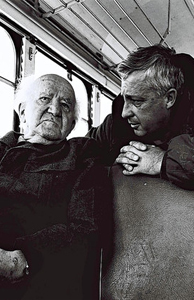 |
"Two new books about Israeli leaders share some common ground. Both are written by authors who were intimately acquainted with their subject. Both depict this subject as someone of great strategic vision and willpower, able to make and carry out fateful decisions shied from by others. Both are openly partisan narrations. Yet starting with the slimness of one book and the bulk of the other, this is as far as the likeness goes. Shimon Peres's "Ben-Gurion: A Political Life" is the work of a prominent politician himself. Done "in conversation" with Israeli journalist David Landau, it is an urbane account of Israel's first and longest-serving prime minister by someone who, though nearly 40 years younger, worked closely with him for two decades. It is admiring of Ben-Gurion and takes his side against his opponents, but it never lapses into hero worship or loses its grip on the historical realities amid which its story is set. This cannot be said of "Sharon: The Life of a Leader," an adulatory description of a father's career by a son who can find no fault with it. At times, Gilad Sharon's book reads less like a biography than an extended eulogy, even though Ariel Sharon is not dead but comatose from a massive stroke suffered nearly six years ago." |
||
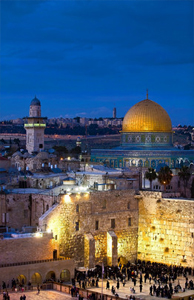 |
"Great cities generally have a reason for being where they are. New York, Athens, Alexandria and Shanghai are seaports, gateways to a continent. London, Paris, Vienna and Berlin straddle a navigable river. Montreal, Madrid and Beijing command strategic heights. Alone among great cities, Jerusalem has no obvious purpose. It lacks access to a sea or waterway and surveys nothing grander than scrubby hills on one side and desert on the other. The ancient trade routes from Asia to Europe ran 150 miles north through Aleppo and south through Petra. In military terms the city is indefensible, easy to besiege. For want of water, it spouts rivers of blood. There have been many histories of Jerusalem, from Jeremiah's sixth century B.C. monody to "For Jerusalem," a premature happy ending (written in the 1970s) by a successful mayor, Teddy Kollek. But Mr. Sebag Montefiore's book is the city's first "biography"—a panoptic narrative of its rulers and citizens, heroes and villains, harlots and saints. In 550 pages, Mr. Sebag Montefiore barely misses a trick or a character in taking us through the city's story with compelling, breathless tension. The lone drawback to his book's impressive scope is a lack of nuance in appreciating the filigree detail of Hebrew and Arabic." Read more of the book review here.
|
||
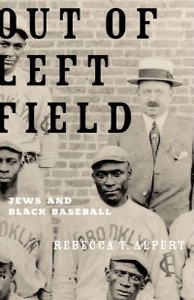 |
"Baseball, as Alpert puts it, “was America.” The respect and love of Robinson and his attainments allowed many liberal Jews, who identified with the black struggle in America, to combine an attachment to the national pastime — especially to the newly integrated Brooklyn Dodgers — with the belief in the value of the social equality, which they learned at home. At the same time that they were becoming more American, they could hold on to ethnic distinctiveness and to the value of justice crucial to it. Alpert recognizes this intricate process of identity construction on her very first page, where she tells us that her own American Jewish progressivism was shaped in part by her mother, who taught her about Robinson, Jews and the Negro League, and by Jewish support and activism for the integration of professional baseball. Thousands of other Jewish children heard the same teachings. For example, in 1947, my grandmother presented 7-year-old me with a fully uniformed, batwielding Jackie Robinson doll, along with a speech — not her last — about social equality. During Alpert’s research, however, she discovered that the role Jews played in black baseball was decidedly less heroic and more complex than she had been led to believe. Beginning in the Depression era, a small number of Jews of Eastern European descent ventured into the sports business and came to wield an economic and social power in black baseball that was denied them in other arenas. They inevitably competed with a minority of black owners and agents less well capitalized, and sometimes, in order to stimulate attendance, encouraged (but did not invent) a vaudevillian style of play uncomfortably resembling minstrelsy." |
||
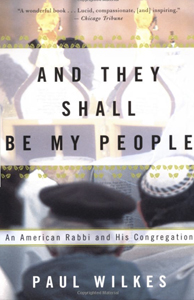 |
Booklist says: Wilkes, an award-winning writer and a Catholic, spent one year with Jay Rosenbaum, the 42-year-old rabbi of Congregation Beth Israel, a Conservative synagogue in an upper-middle-class community in Worcester, Massachusetts. Wilkes followed Rabbi Rosenbaum on his daily rounds--leading the services, performing weddings and conducting funerals, teaching children, and counseling couples. Wilkes interviewed the rabbi, the rabbi's wife, and some of the synagogue members. The rabbi had been at Beth Israel for six years, had started many new programs, and had begun to reverse the demographic trend, attracting younger families into what had been an aging synagogue. But he wanted his people to live more intensely Jewish lives. Consequently, the book explores the complex question, What is the place of the Jewish religion in today's lifestyle? In seeking the answer, Wilkes has written an important book, focusing on a religion at a perilous juncture in time. Click here to read an interview with the author, Paul Wilkes.
|
||
 |
"Markus Zusak has not really written "Harry Potter and the Holocaust." It just feels that way. "The Book Thief" is perched on the cusp between grown-up and young-adult fiction, and it is loaded with librarian appeal. It deplores human misery. It celebrates the power of language. It may encourage adolescents to read. It has an element of the fanciful. And it's a book that bestows a self-congratulatory glow upon anyone willing to grapple with it. To be sure, "The Book Thief" attempts and achieves great final moments of tear-jerking sentiment. And Liesel is a fine heroine, a memorably strong and dauntless girl. But for every startlingly rebellious episode — Rudy's Führer-baiting impersonation of the black American athlete Jesse Owens, the building of an indoor snowman for a Jew in hiding, the creation of books and drawings that frame Liesel and Max's experiences as life-affirming fairy tales — there are moments that are slack. "The Book Thief" will be appreciated for Mr. Zusak's audacity, also on display in his earlier "I Am the Messenger." It will be widely read and admired because it tells a story in which books become treasures. And because there's no arguing with a sentiment like that." Read the complete review by the NY Times. |
||
 |
The website is now the book. Very Funny! |
||
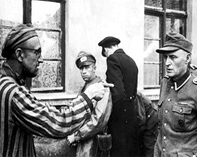 |
"Michael Burleigh has seen and filled an opening in the history of World War II. Diplomatic and military historians, respectful of the guilds of which they regard themselves as honorary members, tend not to pose moral questions too sharply. The cultural and social historians are eager to pose moral questions but often lack the concern for high politics necessary to pose them in the right places. In "Moral Combat," Mr. Burleigh forces a confrontation between the two: He poses the moral questions to the people that mattered at the great turning points of a vast war. For the most part, these are familiar moments of Allied history: the decisions to bomb German cities but not Auschwitz, to use nuclear weapons against Japan but spare its emperor. Mr. Burleigh is at his best when he recalls the professional ethics of officers wishing to save their men and when he describes the rough morality that emerged among soldiers." Click here to read the full review. | ||
Two new book reviews on the Holocaust by the Jewish Forward |
|||
 |
Hosting a Seder? Thinking about Passover? JewishBoston.com can help! Maxwell House won't cut it this year? Ready for a change? This is not your grandfather's seder! Enjoy your own The Wandering is Over Haggadah, downloadable right from here. This thirty-minute version includes optional supplements, discussions, and Passover songs. Think it's too long? Not long enough? You can choose either the PDF version or the Microsoft Word option, which enables you to add or delete whatever you'd like. Go ahead, have Passover your way. |
||
 |
Two relatively new books tell the story of American Jewry, weaving together its past and present by examining tradition and making it relevant to today’s reader. Where Sue Fishkoff’s "Kosher Nation: Why More and More of America’s Food Answers to a Higher Authority" (Schocken, 2010) is robust and detailed, Leah Koenig’s "The Hadassah Everyday Cookbook: Daily Meals for the Contemporary Jewish Kitchen" (Universe, 2011) is spacious and adaptable. With the "The Hadassah Everyday Cookbook," Hadassah, The Women’s Zionist Organization of America has attempted to free itself from the matzah ball-and-chain and community cookbooks of its nearly 90-year past and plunge itself into the present-day reality of America’s Jewish kitchen. An increased interest in local and healthy food, and the amplified availability of kosher-certified products -- with an assist from popular television shows -- have created a market of ever-more sophisticated American Jewish consumers, and Koenig doesn't shy away from using trendy food items such as quinoa, miso and pomegranate. Throughout "Kosher Nation," Fishkoff regards her subjects with objectivity. Even the most zealous figures -- like the Chasid on a one-woman campaign to prevent Jews from ingesting insects -- become sympathetic and even relatable. It is clear that Fishkoff was fascinated by the subject; the reader cannot help but be fascinated, too. For anyone who remembers when Oreos became kosher, notices when sushi is served at an Orthodox wedding or simply wants to take a bite out of Jewish Americana, "Kosher Nation" offers a readable, in-depth exploration into the cultural shifts and subtleties surrounding the rise of an industry. Paired with "The Hadassah Everyday Cookbook," readers have a chance to re-examine food traditions far beyond the holiday table. Dipping back into the origins of the kosher industry in America and then cooking recipes that reflect a contemporary kosher reality prove a filling and fulfilling experience. Click here to read the complete review in JTA. |
||
 |
Click here to see a list of My Jewish Learnings Top 100 Jewish Books My Jewish Learning looks at the life and scholarship of Chaim Potok. As a doctor of philosophy, a rabbi, and a biblical commentator, Chaim Potok (1929-2002) had a lot to say. He would often wake at four or five in the morning, driven to wakefulness--because, he would say, of the sentences in his head. But foremost among his talents, Potok was a writer. Often his most profound thoughts and arguments would come not from his own mouth, but from the mouths of his fictional characters. Click here for details. |
||
 |
"The emergence of Israel in Canaan is perhaps the most debated topic in biblical/Syro-Palestinian archaeology, and related fields. Accordingly, it has received a great deal of attention in recent years, both in scholarly literature and in popular publications.Generally speaking, however, the archaeology of ancient Israel is wedged in a paradoxical situation. Despite the large existing database of archaeological finds (from thousands of excavations conducted over an extremely limited area) scholars in this (sub)discipline typically do not engage in theoretical (anthropological) discussions, thus exposing a large gap between it and other branches of archaeology, in this respect. Numerous archaeologically oriented studies of Israelite ethnicity are still conducted largely in the spirit of the culture history school, and are absent of thorough reference to the work of more recent critics, which, at best, make a selected appearance in these analyses.Israel's Ethnogenesis provides an anthropologically-oriented perspective on the discussion of Israel's ethnogenesis. This monograph incorporates detailed archaeological data and relevant textual sources, within an anthropological framework. Moreover, it contributes to the archeology of ethnicity, a field which currently attracts significant attention of archaeologists and anthropologists all over the world. Making use of an unparalleled archaeological database from ancient Israel, this volume has much to offer to the ongoing debate over the nature of ethnicity in general, and to the understudied question of how ethnic groups evolve (ethnogenesis), in particular." Recommended by Joe Silverman and review from Amazon.com. | ||
 |
This coming April marks 150 years since the outbreak of the American Civil War. The role of Jews in that conflict became a subject of historical inquiry in the context of rising anti-Semitism, about a quarter-century after hostilities ended. An article defending the patriotism of American Jews, appearing in 1891 in the prestigious North American Review, recalled that, on both sides of the Civil War, “the American Israelites stood shoulder to shoulder with their fellow-citizens of all other races and creeds.” One J.M. Rogers, who described himself as a former Union soldier and Army recruiter, responded in a letter to the editor, “I cannot recall meeting one Jew in uniform or hearing of any Jewish soldier.” This hardly surprised Rogers, “For we know from the Hebrew scriptures that the children of Abraham were terrible warriors.” |
||
 |
Winner of the 2010 Man Booker Prize Julian Treslove, a professionally unspectacular former BBC radio producer, and Sam Finkler, a popular Jewish philosopher, writer, and television personality, are old school friends. Despite a prickly relationship and very different lives, they've never lost touch with each other, or with their former teacher, Libor Sevcik. Dining together one night at Sevcik's apartment—the two Jewish widowers and the unmarried Gentile, Treslove—the men share a sweetly painful evening, reminiscing on a time before they had loved and lost, before they had prized anything greatly enough to fear the loss of it. But as Treslove makes his way home, he is attacked and mugged outside a violin dealer's window. Treslove is convinced the crime was a misdirected act of anti-Semitism, and in its aftermath, his whole sense of self will ineluctably change. The Finkler Question is a funny, furious, unflinching novel of friendship and loss, exclusion and belonging, and the wisdom and humanity of maturity. |
||
 |
Why I Wrote "Jews & Money" It wasn't any particular comment during the financial crisis that led me to write "Jews and Money: The Story of a Stereotype." Rather it was the cumulative effect of a host of anti-Semitic statements focusing on money matters together with the uncertain environment in which Jews were living that provided the imperative for me to return to the world of authorship, my vow never to return notwithstanding. |
||
 |
Robert D. Putnam is one of those Harvard University professors respected for his scholarly research and celebrated for the masterful way he connects it to the narrative of modern life. When he wrote that Americans were “bowling alone” — and therefore no longer building up “social capital,” the trust, informal networks and energetic communities necessary for a healthy, engaged democracy — his indictment of civic life in a book with that catchy title drew the attention of White House policymakers and influenced a generation of political scientists. So the October publication of his latest book, “American Grace: How Religion Divides and Unites Us,” was greeted with much anticipation, and it does not disappoint. Crunching decades of data, Putnam and co-author David E. Campbell went searching for the roots of interfaith tolerance and found that even though religious practice in America trends toward polarization, it is tempered by an acceptance based on familiarity. Knowing someone of another faith — and increasingly, Americans do — makes us more tolerant of those who hold that faith.
|
||
 |
In the two decades following the establishment of the state of Israel, approximately 850,000 Jews were forcibly driven out of Arab lands. Their expulsion marked the beginning of the end of 2,500 years of Jewish life in North Africa, the greater Middle East, and the Persian Gulf. Until recently, their story has been largely unrecognized and untold in the English-speaking world. That is the task undertaken by the British historian Martin Gilbert, known for his multi-volume biography of Winston Churchill and many works on Jewish history, in his new book, In Ishmael's House: A History of Jews in Muslim Lands. Ambitious to a fault, Gilbert begins his saga a full millennium before the birth of Muhammad in the late 6th century C.E., and by the end of his first 100 pages has covered the first centuries of Islam, the age of the Crusaders, and the spread of the Ottoman empire. The remaining two-thirds of the book are devoted to the past 100 years. Here he traces the competition between the Jewish and Arab national movements during World Wars I and II, the various reactions to the 1947 UN partition resolution and the creation of Israel, Jewish life in Muslim lands since 1948, and the integration of Jews from Muslim lands into Western countries and, of course, Israel. |
||
 |
The fourth in the great and undiminished Roth’s recent cycle of short novels follows Everyman (2006), Indignation (2008), and The Humbug (2009), and as exceptional as those novels are, this latest in the series far exceeds its predecessors in both emotion and intellect. In general terms, the novel is a staggering visit to a time and place when a monumental health crisis dominated the way people led their day-to-day lives. Newark, New Jersey, in the early 1940s (a common setting for this author) experienced, as the war in Europe was looking better for the Allies, a scare as deadly as warfare. The city has been hit by an epidemic of polio. Of course, at that time, how the disease spread and its cure were unknown. The city is in a panic, with residents so suspicious of other individuals and ethnic groups that emotions quickly escalate into hostility and even rage. Our hero, and he proves truly heroic, is Bucky Canter, playground director in the Jewish neighborhood of Newark. As the summer progresses, Bucky sees more and more of his teenage charges succumb to the disease. When an opportunity presents itself to leave the city for work in a Catskills summer camp, Bucky is torn between personal safety and personal duty. What happens is heartbreaking, but the joy of having met Bucky redeems any residual sadness. --Brad Hooper |
||
 |
When They Come for Us, We'll Be Gone: The Epic Struggle to Save Soviet Jewry by Late in the twentieth century, the three great population centers for Jews were the U.S., the Soviet Union, and Israel. This absorbing and inspiring story moves between those three nations to recount one of the most extraordinary episodes in recent Jewish history. This was the survival (and in many cases a rediscovery) of a sense of Jewish identity among Soviet Jews, which led thousands of them to demand the right to emigrate to Israel. Beckerman is a reporter for the Jewish daily publication The Forward. His narrative moves between the centers and also moves back in time to describe Jewish life in the Soviet Union. His description of the Nazi slaughter of Latvian Jews is horrifying, but the slow strangulation of Jewish culture under Stalin and his successors is almost as repellent, because it had the clear intention of causing spiritual death. Once a remarkable rebirth of Jewish consciousness and assertiveness emerged, supporters in the U.S. played a vital role, through demonstrations and indefatigable lobbying efforts to pressure the Soviet government to allow Jewish “refuseniks” to emigrate. This is an outstanding chronicle of a great effort conducted by determined and courageous men and women. --Jay Freeman Read a review from The Jewish Forward.
|
||
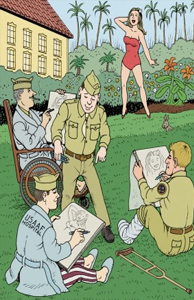 |
Al Jaffee’s inventive work has enlivened the pages of MAD since 1955. To date he has pickled three generations of American kids in the brine of satire, and continues to bring millions of childhoods to untimely ends with the knowledge that parents are hypocrites, teachers are dummies, politicians are liars, and life isn’t fair. Jaffee’s work for MAD has made him a cultural icon, but the compelling and at times bizarre story of his life has yet to be told. A synopsis of Jaffee’s formative years alone reads like a comic strip of traumatic cliff-hangers with cartoons by Jaffee and captions by Freud. Six-year-old Jaffee was separated from his father, uprooted from his home in Savannah, Georgia, and transplanted by his mother to a shtetl in Lithuania, a nineteenth-century world of kerosene lamps, outhouses, physical abuse, and near starvation. He would be rescued by his father, returned to America, taken yet again by his mother back to the shtetl, and once again rescued by his father, even as Hitler was on the march. When he finally settled back in America as a twelve-year-old wearing cobbled shoes and speaking his native English with a Yiddish accent, schoolmates called him “greenhorn.” He struggled with challenges at least as great as those he had met in Europe. His luck changed, however, when he was chosen to be a member of the first class to attend New York City’s High School of Music and Art. There his artistic ability saved him. He would go on to forge relationships with Stan Lee, Harvey Kurtzman, and Will Elder, launching a career that would bring him to MAD magazine. There he found himself at the forefront of a movement that would change the face of humor and cartooning in America. A cliff-hanger of a life deserves a page-turner of a biography, and that is what Mary-Lou Weisman and Al Jaffee have delivered. Read a full review from The Forward and from The NY Times.
|
||
 |
The Forward, the Jewish Daily, has just published it's Fall 2010 book review. Click here for their recommendations. The Forward also has a new review of Wearing Europe’s Tattoo
|
||
 |
Less than two decades after Theodor Herzl inaugurated the Zionist movement with his book "Der Judenstaat" ("The Jewish State"), the British government, in 1917, issued the Balfour Declaration, promising to use its best efforts to establish a home in Palestine for the Jewish people. Hailed as a milestone by Zionists—and still mourned in the Arab world as the first step toward what it regards as the "catastrophe" of the founding of the state of Israel—this extraordinary promise, made in a public letter written by Arthur Balfour, the British foreign secretary, proved to be even more momentous than it seemed at the time. It is now the subject of Jonathan Schneer's analytical narrative and contextual history, "The Balfour Declaration." By issuing the declaration, as Mr. Schneer notes, Britain was making a promise that seemed to contradict one that it had made to Arab leaders, who had risen up against the Ottoman Empire in 1916-18 in the expectation that they would be rewarded with postwar Arab nation-states. But at that moment in history—in the middle of World War I, with the outcome very much in doubt—Britain was prepared to make all sorts of promises, some contradictory. And so it came to pass that Britain's war cabinet, in search of support and wartime allies and in keeping with Britain's prewar affinity for the Zionist goal, agreed to consider a draft document from the London Zionist Political Committee about a Jewish homeland. The draft proposed that "Palestine be reconstituted as the National Home of the Jewish people" and that Britain "use its best endeavours to secure the achievement of this object." Contemplating the events of 1917, it is worth heeding some of Mr. Schneer's opening words: "The Balfour Declaration was not, in and of itself, the source of trouble in a land that previously had been more or less at peace, but nor was it a mere signpost on a road heading undivertibly toward a cliff. No one can say what the course of events in Palestine might have been without it. What did come was the product of forces and factors entirely unforeseen." |
||
 |
The premise for Start-Up Nation: The Story of Israel's Economic Miracle, by Dan Senor and Saul Singer, is simple. How has a nation of just seven million people, only a little more than 60 years old, surrounded by enemies and with no natural resources, produced more start-up companies and produced more Nasdaq-quoted companies than Europe, Japan, China, India and Korea combined? What magic dust does Israel possess to foster this entrepreneurial spirit? This book tries to answer that question, while also examining the potential threats to Israel’s future wellbeing. It has a lively opening with case studies of innovation from recent years including one about a young Israeli who has developed a car battery that could make electric vehicles financially viable. The book concludes with a synopsis of a long meeting between the authors – both American Jews – and ex-PM Shimon Peres, also a former Nobel Prize winner. His advice is to forget the “old industries.” Pick five new ones and go for them hammer and tongs. Be a world leader. It sounds like good advice. |
||
 |
Moses Montefiore, a world-renowned figure in the 19th century, was virtually forgotten by the 20th and is remembered today, at times, simply by the resonance of his name. A hospital in the Bronx is named for him, another in Pittsburgh, and a Jewish quarter in Jerusalem just outside the Old City. The accomplishments of some of Montefiore's descendants—including a pugnacious Anglican bishop—may remind us the progenitor's renown, but his story certainly needs to be retold. It is a remarkable one. Born in Livorno in 1784 to an Italian-Jewish family with British connections, Montefiore moved to London with his family when he was a small child. He began his working life in London's merchant world and then becoming a broker at the stock exchange. He had a most spectacular career, marrying into the Rothschild family and eventually joining its banking enterprise. By an early age he had acquired a great fortune. He was accepted by the best social clubs and even became a member of the Royal Society. He was knighted at the age of 51 and made sheriff of the city of London, a largely ceremonial position but a highly prestigious one. Montefiore was a man of probity in a larger, public sense. As much as he liked making money, he liked even more giving it away to those who needed it more than he did. And so, at what will now be considered early middle age, he retired from business and devoted the rest of his life (he died in 1885, at the age of 101) to acting as a one-person first-aid flying brigade, donating his money to worthy causes and traveling to places where his brethren in faith were persecuted—from Morocco to Palestine, from Russia and Rumania. He became a folk hero of the persecuted, who attributed to him extraordinary powers. He traveled everywhere at a time when travel was often difficult. He went Jerusalem for the last time at age 91, braving cholera and pirates. Ms. Green writes deftly and tells Montefiore's story with a admirable thoroughness. Click here to read the complete review.
|
||
 |
In April 1933, during the early months of Nazi rule in Germany, the "Aryan Paragraph," as it came to be called, went into effect. A new law banned anyone of Jewish descent from government employment. Hitler's assault on the Jews—already so evidently under way in his toxic rhetoric and in the ideological imperatives of his party—was moving into a crushing legal phase. German churches, which relied on state support, now faced a choice: preserve their subsidies by dismissing their pastors and employees with Jewish blood—or resist. Most Protestant and Catholic leaders fell into line, visibly currying favor with the regime or quietly complying with its edict. Such ready capitulation makes the views of Dietrich Bonhoeffer, a young Lutheran theologian in Hitler's Germany, all the more remarkable. Within days of the new law's promulgation, the 27-year-old pastor published an essay titled "The Church and the Jewish Question," in which he challenged the legitimacy of a regime that contravened the tenets of Christianity. The churches of Germany, he wrote, shared "an unconditional obligation" to help the victims of an unjust state "even if they [the victims] do not belong to the Christian community." He went further: Christians might be called upon not only to "bandage the victims under the wheel" of oppression but "to put a spoke in the wheel itself." Before the decade was out, Bonhoeffer would join a conspiracy to assassinate Hitler and pay for such action with his life. In "Bonhoeffer: Pastor, Martyr, Prophet, Spy," Eric Metaxas tells Bonhoeffer's story with passion and theological sophistication, often challenging revisionist accounts that make Bonhoeffer out to be a "humanist" or ethicist for whom religious doctrine was easily disposable. In "Bonhoeffer" we meet a complex, provocative figure: an orthodox Christian who, at a grave historical moment, rejected what he called "cheap grace"—belief without bold and sacrificial action. Mr. Loconte is a senior lecturer in politics at the King's College in New York City and the editor of "The End of Illusions: Religious Leaders Confront Hitler's Gathering Storm." Read the full review here.
|
||
 |
"The Ghosts of Martyrs Square," Michael Young's luminous account of the past five tumultuous years of Lebanon's history. What was it that Mr. Young, then 20 years old, saw that morning? There were Muslim worshipers on deck "bent in prayer." There was a tall woman, an East European croupier from the ship's casino, walking past the faithful "in an afterthought of a miniskirt." There were "dozens of Lebanese still electrified by the night of gambling, their safari suits sodden with perspiration and scotch." Taken together, Mr. Young writes, it was a picture of "Lebanon's peculiar liberalism, a liberalism infused with the ideal of the many instead of the one." Today Mr. Young, the son of an American father and a Lebanese mother, edits the opinion pages of the Daily Star, Beirut's English- language daily. It is a background—and a perch—that allows him to write with authority on a subject typified by antithesis, paradox, surprise and inescapability. Mr. Young's book is peopled by characters who are blind to the ways in which their own sectarian identities limit their ability to effect political change. Of the liberal idealists of the March 14 movement, Mr. Young writes that they had "misdiagnosed the nature of their protests, seeing them as a lever for change when they ended up being mainly a mechanism for balance" within the country's sectarian system. Lebanon's inherent pluralism can impose a political equilibrium that resists tyranny and creates spaces for personal freedom, it is also incapable of establishing conditions for a genuinely democratic political order. Lebanon, Mr. Young observes, allows its people to be who they are but not what they want to be. Those who seek to impose their will on the country by force of personality or by dint of political vision invariably come to ruin. This is not, however, a counsel to leave well enough alone, much less (as some Western analysts would prefer) to deliver Lebanon into the hands of whoever can provide a semblance of stability. "If Lebanon can find a more durable social contract in the years to come," Mr. Young writes, "it will do so thanks to the efforts of modest men and women, those who have a realistic understanding of the recompenses and constraints of their system, not the visionaries who will burden the system with their egoism." It is a gentle suggestion for which there is much to be said. So too for this book, which transcends the usual limitations of the current-events genre to offer a masterly portrait of the human condition in circumstances of unique stress. Mr. Stephens is the Journal's foreign affairs columnist and a deputy editorial-page editor. Read full review here.
|
||
 |
Judaism: A Way of Being, David Gelernter, Yale, November 2009 Today, as Jews celebrate Passover and tell the story of the Exodus from Egypt during the traditional Passover ritual meal, the Seder, they will figuratively re-enact the story of their own creation as a nation. The transition from slavery to freedom—the wandering through the Wilderness, during which the Jews receive the Ten Commandments, and the eventual arrival in the land of Israel—is the dominant historical theme in Judaism. But as David Gelernter explains in "Judaism: A Way of Being," the Exodus can be understood as a metaphor for the creation of the world. Just as God parted the waters of the Red Sea to enable the Jews to flee Egypt and escape bondage, he first divided "the waters from the waters" to create the firmament and make an earthly place for life itself. Throughout "Judaism," Mr. Gelernter uses imagery to amplify understanding. He notes that Judaism is filled with powerful images—the seven-branched Temple menorah, the Star of David, the tablets of the Ten Commandments. To grasp the essence of Judaism is to read the messages of these images or at least to contemplate their potential meaning. When Moses, upon first encountering God, sees a burning bush that is not consumed, Mr. Gelernter infers a metaphor for all of Jewish history: "Jews are slaughtered yet Israel is not consumed." The book includes images of Mr. Gelernter's own devising, too: color plates of eight paintings by the author, each named by a Hebrew phrase. Perhaps the most evocative shows orange brushstrokes across a burgundy-and-purple field of Rothko-like color. Hebrew letters spell out a phrase that is sung aloud in synagogue each sabbath at the conclusion of the Torah-reading service. It is from Lamentations and can be translated thus: "Make us new again, as we used to be." Read full rview here. Reviewed by Jay Lefkowitz, Wall Street Journal, March 29, 2010 |
||
 |
Have a Little Faith, Mitch Albom, Hyperion, September 2009 In Have a Little Faith, Mitch Albom offers a beautifully written story of a remarkable eight-year journey between two worlds--two men, two faiths, two communities--that will inspire readers everywhere. Albom's first nonfiction book since Tuesdays with Morrie, Have a Little Faith begins with an unusual request: an eighty-two-year-old rabbi from Albom's old hometown asks him to deliver his eulogy. Feeling unworthy, Albom insists on understanding the man better, which throws him back into a world of faith he'd left years ago. Meanwhile, closer to his current home, Albom becomes involved with a Detroit pastor--a reformed drug dealer and convict--who preaches to the poor and homeless in a decaying church with a hole in its roof. Moving between their worlds, Christian and Jewish, African-American and white, impoverished and well-to-do, Albom observes how these very different men employ faith similarly in fighting for survival: the older, suburban rabbi embracing it as death approaches; the younger, inner-city pastor relying on it to keep himself and his church afloat. Albom and the two men of God explore issues that perplex modern man: how to endure when difficult things happen; what heaven is; intermarriage; forgiveness; doubting God; and the importance of faith in trying times. Although the texts, prayers, and histories are different, Albom begins to recognize a striking unity between the two worlds--and indeed, between beliefs everywhere. Have a Little Faith is a book about a life's purpose; about losing belief and finding it again; about the divine spark inside us all. It is one man's journey, but it is everyone's story. - Publishers Weekly I did not enjoy this authors fictional books, but I found this short story to be insightful and a good read. - Michael Cohen, 1/8/10
|
||
 |
A Million Miles in a Thousand Years, Donald Miller, Thomas Nelson, September 2009 Years after writing a best-selling memoir, Donald Miller went into a funk and spent months sleeping in and avoiding his publisher. One story had ended, and Don was unsure how to start another. But he gets rescued by two movie producers who want to make a movie based on his memoir. When they start fictionalizing Don's life for film--changing a meandering memoir into a structured narrative--the real-life Don starts a journey to edit his actual life into a better story. A Million Miles in a Thousand Years details that journey and challenges readers to reconsider what they strive for in life. It shows how to get a second chance at life the first time around. In desultory fashion, Miller sets out to change his own life—to be the kind of guy who seeks out his father, chases the girl and undertakes a quest. Along the way, he comes to understand God as a master storyteller who doesn't quite control where his characters are going. An unexpected bonus of this book is Miller's insights into the writing process. - Publishers Weekly While not about Judaism, this book explores our role in the world and discusses the type of people we want to become. I enjoyed the book very much. - Michael Cohen, 1/8/10
|
||
 |
We Were Merchants by Hans Sternberg and James Shelley, LSU Press, 2009 This oversize book, generously illustrated with black-and-white photographs, recounts the journey of Erich and Lea Sternberg, Jewish immigrants who escaped with their daughter and two sons from the Nazi terror in Germany in the 1930s and, speaking no English, went into the department-store business in the Deep South. "We Were Merchants" also describes how the Sternberg family— Erich and Lea would eventually be joined at work by their sons, Hans and Josef, and daughter, Insa—spent the next half-century building up what became the country's largest family-owned department store, acquiring other stores along the way. The story of Goudchaux's success is related by Hans Sternberg with James E. Shelledy, a former newspaper reporter who teaches journalism at Louisiana State University. The book also yields some simple but oft-forgotten truths about what makes great brands, and some enduring lessons for retailers. Hidden in the book's anecdotes are bedrock principles that get mere lip-service from most retailers today: loyalty to employees, giving back to the local community and customer care. Readers might have been happy to take the devotion of Goudchaux's customers on faith, but the book is unhelpfully sprinkled with sometimes treacly tributes from longtime patrons. Reviewed by Mark Robichaux, The Wall Street Journal, October 10, 2009 |
||
|
America's Prophet, Moses and the American Story by Bruce Feiler, Morrow, 2009 Feiler even scored an Oval Office audience with then-president George W. Bush (a fan of his book on Abraham). Bush famously referred to Jesus as his favorite philosopher; one suspects that after reading Feiler’s new book, the former commander in chief would change his answer to Moses. In clear, engaging prose, Feiler demonstrates how the figure of Moses appealed to Americans across political and religious spectrums. Puritans and freethinkers, slaves and slave owners, capitalists and communists, Mormons and Jews, gay rights activists and computer moguls have looked to Moses as a leader and to the Exodus narrative as a template for their causes. This persistence of Moses in the American imagination, Feiler argues, is attributable to the fact that the motifs of the biblical narrative — overcoming oppression, balancing a desire for liberty (Exodus) and the need for order (Sinai), establishing a just social order — have proved so pertinent to our historical experience. Feiler concludes that “Moses actually helped shape American history and values, helped define the American dream, and helped create America.” That’s not quite right, of course. It wasn’t Moses who shaped America, but Americans who saw themselves as the “newly chosen” (or, in Lincoln’s famous phrase, “almost chosen”) people and attempted to shape the country accordingly. But as Feiler has shown, Americans also shaped the Moses whom they took for a model and a teacher — a prophet fashioned and constantly refashioned in our own likenesses. Reviewed by Jerome Copulsky, The Jewish Daily Forward, October 16, 2009 |
||
 |
Sarah's Key, Tatiana de Rosnay, St. Martin's Press, 2009 From the Publisher: Paris, July 1942: Sarah, a ten year-old girl, is brutally arrested with her family by the French police in the Vel’ d’Hiv’ roundup, but not before she locks her younger brother in a cupboard in the family's apartment, thinking that she will be back within a few hours. Paris, May 2002: On Vel’ d’Hiv’s 60th anniversary, journalist Julia Jarmond is asked to write an article about this black day in France's past. Through her contemporary investigation, she stumbles onto a trail of long-hidden family secrets that connect her to Sarah. Julia finds herself compelled to retrace the girl's ordeal, from that terrible term in the Vel d'Hiv', to the camps, and beyond. As she probes into Sarah's past, she begins to question her own place in France, and to reevaluate her marriage and her life. Tatiana de Rosnay offers us a brilliantly subtle, compelling portrait of France under occupation and reveals the taboos and silence that surround this painful episode. While this book is a work of fiction, the Vel' d'Hiv round did indeed occur on July 16, 1942, during the occupation of France by the Germans. The roundup, in Paris, was conducted by the French police on Jewish French citizens. The victims, including thousands of children, were sent to French concentration camps and then to their deaths at Auschwitz. Few survived. French president Jacques Chirac apologized in 1995 for the role of French policemen and civil servants in the roundup. Overall the book is excellent, especially the first half that deals with most of the historical details. It is amazing that this incident is not more well known. Here is a link to a Youtube video with the author.
Reviewed by Michael Cohen - 10/15/09 |
||
 |
Why Are Jews Liberals? by Norman Podhoretz, Doubleday, 2009 In a conference call with more than 1,000 rabbis before Rosh Hashanah, President Barack Obama encouraged the religious leaders to use their sermons on the Jewish New Year to promote health-care reform. It is more than ironic that liberal Jews, who call for a complete separation of church and state, saw nothing wrong with the president scripting their sermons. The reason may be that the script came from a modern sort of Jewish holy book, what Norman Podhoretz calls the "Torah of liberalism." "Why Are Jews Liberals?" is a fine and bracing examination of a question that has vexed Mr. Podhoretz for decades. He displays, along the way, the skill for supple reasoning and pugnacious argument that was the hallmark of his long editorship of Commentary magazine. Mr. Podhoretz grew up on the political left and remained there until the late 1960s, when he moved to the right. In "Why Are Jews Liberals?" he ponders, with a sense of deep frustration, why so few other Jews have made his journey. During Rosh Hashanah services last weekend, I saw these words embedded in a stained-glass window at my synagogue: "God, the Torah and Israel are One." I'm still willing to accept that most American Jews believe these are the cornerstones of their faith. What is less clear is whether for many liberal Jews their Torah is Jewish law or the Torah of liberalism that Mr. Podhoretz describes with unsettling clarity. Check out the complete review here Reviewed by Richard Baehr, The Wall Street Journal - 9/25/09 |
||
 |
The Case For Moral Clarity: Israel, Hamas and Gaza by Alan M. Dershowitz, Camera Monograph Series, 2009 It seems that any rational and unbiased human being would understand the need to defend oneself from suicide murders, and unprovoked and indiscriminate missile attacks. Yet it seems that Israel continues to be consistently condemned for trying to protect its citizens. This book is a collection of interview transcripts and editorials the author has published over the last nine months in support of Israel and it’s right to defend itself. Dershowitz questions why the international community cannot distinguish between self defense and terrorism. He asks why terrorism or the murder of innocent Israeli children is accepted and a democracy is not allowed to protect its own people. Why can Hamas use human shields, and the death of it’s own people to win a war of propaganda without being held responsible for needless deaths? Dershowitz clearly makes the case for the double immoral crimes of Hamas and exposes those who support this evil tactic of sacrificing human lives. The book’s cover says it all: Reviewed by Michael Cohen – 8/30/09 |
||
 |
The Accidental Billionaires: The Founding of Facebook A Tale of Sex, Money, Genius and Betrayal by Ben Mezrich, Doubleday 2009 Whenever I walk near my daughter while she is on the computer the screen immediately goes blank. It is clear that I am not invited to see what is happening in the teenage world of Facebook. But Facebook is no longer limited to “young people” but is now an international phenomena of millions of people communicating in ways never before imagined. Ben Mezrich chronicles the rise of Facebook from the dorm rooms of Harvard University to the top of the social networking world. Using a dramatic narrative style, Mezrich’s book is not Pulitzer Prize writing by any means but does tell the story to two geeky Jewish outsiders and their rise to social stardom. Critics are not kind to the book with regard to the narrative style or the possible looseness of the facts but you get the basic story that was not without some entertainment value. Perfect for an afternoon on the beach or a long plane flight, I’m sure a movie is soon to follow, as was a previous Mezrich book, Bring Down the House, that went to the big screen as the movie 21. Enjoyed the book but wait for the paperback: Reviewed by Michael Cohen – 8/30/09 |
||
 |
$20 per Gallon: How the Inevitable Rise in the Price of Gasoline Will Change Our Lives for the Better, Christopher Steiner, Grand Central Publishing 2009 When the price of gasoline recently soared toward $4 people couldn’t wait to get rid of their gas guzzling SUV’s and find a more energy efficient hybrid vehicle. Now that gas has returned to a less painful price smaller cars again sit for months on car dealer’s lots. If we thought there was a panic at $4 gas one can only imagine the ways our lives will change with gas at $20 a gallon. Christopher Steiner lays out the possible changes to our lives as gas rises in $2 increments from $4 gas to $20 gas. Not all of these changes may be bad but change will be significant. It seems that our society has always found new technologies to prevent the need to change our behaviors but our reliance on fossil fuels and petroleum products will force everyone to reconsider our lifestyle choices. While change is frightening it is also an opportunity to free ourselves to explore and reexamine opportunities closer to home. The author describes how $20 a gallon gas will help us lead healthier, safer and more community oriented lives. Whether or when the author’s views become reality, I found this book to be very sobering, interesting and a fast read. I enjoyed the book and highly recommend it.
Reviewed by Michael Cohen – 8/30/09 |
||
 |
The Last Ember, Daniel Levin, Riverhead Publishing, 2009 It may be a coincidence — or just good marketing — but it seems as if many publishers are launching mysteries that deal with myths, antiquities or icons before Dan Brown's "The Lost Symbol" comes out Sept. 15. After all, Brown's "The Da Vinci Code" made fiction about symbols and religion palatable for the masses. Getting on the Brown bandwagon before his new novel is published makes good business sense. But whoever thought antiques would be fodder for action? While Daniel Levin's debut deals with Brown-like subjects, this New York-based author is no copy cat. "The Last Ember", out today, is an exciting, action-packed story about history, religion, archaeology, antiques and tension in the Middle East. Realistic characters with believable motives further elevate "The Last Ember." Reviewed by By Oline H. Cogdill, jewishworldreview.com - 8/3/09 Second opinion from the Jerusalem Post
|
||
 |
Kissinger: 1973, the Crucial Year, Alistair Horne, Simon & Schuster, 2009 For Henry Kissinger, 1973 was a banner year. He won the Nobel Peace Prize, topped Gallup's poll as the most admired American and, at the peak of his power, got married. The year looked pretty good for President Richard Nixon, too -- at the start. He had just won re-election in a 48-state landslide, and he seemed to be on the verge of a final peace agreement with Vietnam. He was also looking forward to building on his 1972 foreign-policy triumphs: his historic trips to China and to Moscow. This is where Alistair Horne's story begins. In "Kissinger: 1973, The Crucial Year," Mr. Horne tracks Richard Nixon's calamitous fall and, more important for his purposes, the rise and triumph of Mr. Kissinger, the only senior official in the administration not touched by the Watergate scandal. We already know how the Nixon drama unfolded -- impeachment hearings, prosecutions, the resignations of top advisers and ultimately the resignation of the president himself. But there was more at stake than the fate of the Nixon presidency. Its unraveling took place during one of the most challenging periods in the history of U.S. foreign policy. Reviewed by Jonathan Karl, The Wall Street Journal - 7/2/09 |
||
 |
A Time to Every Purpose, Jonathan Sarna, Basic Books, 2008 The title of the book refers to a passage derived from Ecclesiastes, and Sarna uses it to illustrate how Jews ascribe meaning to their days while marking the passage of time with rites and customs connected to Jewish celebrations. In each chapter addressed to his daughter, Sarna discusses the Jewish holidays in detail, including the meaning and evolution of these holidays. Sarna refers to the Jewish calendar to discuss modern issues facing American Jews today. For example, he highlights Chanuka to focus on assimilation, discusses anti-Semitism in the context of Tisha B’Av, and the environment in the context of Tu B’Shevat. The author brings in some personal history, such as how the meaning of Rosh Hashana was transformed for him the year he was diagnosed with esophageal cancer. He also laments the decline of the world Jewish population due to intermarriage and other reasons with startling facts: More than 60 years after the Holocaust, the worldwide Jewish population still has not recovered. Where once there were 18 million Jews worldwide, now there are only about 13 million. Outside of Israel, only 1.2 of every thousand people in the world is Jewish, probably the smallest percentage of the world that we have been in more than two thousand years. We are — let’s face it — a tiny drop in the world’s bucket. Our numbers are less than the statistical error in the Chinese census. Reviewed by Hilary Daninhirsch, The Jewish Chronicle - 6/4/09 |
||
 |
All Other Nights, Dara Horn, Norton, 2009
In March 1861, blond, blue-eyed Jacob Rappaport of New York is hiding in a barrel on a boat headed to New Orleans. Rappaport, a 19-year-old Jewish private in the Union Army, has been ordered to kill his own uncle, a rabid Confederate plotting President Lincoln's assassination. So begins Dara Horn's "All Other Nights," an enjoyably fast-paced amalgam of historical romance, spy novel and political thriller -- laced with American Jewish history. In New Orleans, Jacob visits a Jewish burial ground, even though stepping through the gates violates an "entire edifice of law and custom" forbidding him, as a descendant of the biblical high priest, from contact with the dead. Then again, he is about to commit murder. His religious faith, it turns out, was in turmoil well before his unapologetically anti-Semitic higher-ups ordered him to kill his uncle. Having joined the military after rejecting an arranged marriage, Jacob has asserted his independence, but he has lost his moral compass. Disguised as a Confederate who has turned against his native North, Jacob arrives at the home of his uncle, Harry Hyams, in time for a Passover Seder prepared and served by slaves. A fellow guest is Judah Benjamin, the Confederate secretary of state, the highest post held in America by a Jewish politician up to that point. Jacob despises Benjamin's slaveholding and pro-South politics but can't help admiring his political brilliance. During the Seder, where Jacob intends to kill his uncle with poison, Hyams discusses his plan to kill Lincoln -- an assassination plot that Benjamin dismisses as egotistical nonsense: "Glory isn't for the Jews, Harry." Reviewed by Emily Bingham, Wall Street Journal - 4/3/09 |
||
 |
The Last Lecture, Randy Pausch, Hyperion 2008
A “last lecture” is an honor given to university professors to speak to their colleagues, students and friends as if they were delivering their last lecture. It is an opportunity to provide a verbal legacy. Carnegie Mellon Professor Randy Pausch was selected by his university for this honor in the spring of 2007. Dr. Pausch was a Professor of computer science, an award winning teacher and researcher, and a well known expert in his field in the science of human computer interaction and design. Soon after receiving the honor of providing a last lecture he was diagnosed with a terminal case of pancreatic cancer and was faced with the realization that he would truly be giving his last lecture. When he went before his university in the fall of 2007, this husband and father of three young children gave a truly inspiring lecture of hopes and dreams. This book is the written and published companion to his final public address and is appropriately titled, The Last Lecture. The reader will be awed not only by the way the author chose to live the last months of his life but be inspired to live life to the fullest and treasure each day. Dr. Pausch would live to the fall of 2008 before succumbing to his illness. This story is a must read and one of the most thought provoking books I have read.
Reviewed by Michael Cohen - 2/23/09 |
||
 |
The Forger’s Spell, Edward Dolnick, Harper 2008
For those who enjoy history and art, The Forger’s Spell is an interesting true story of forgery at it’s highest level. The author, Edward Dolnick, recounts how a middling painter, Han van Meegeren, was able to fool the art world for seven years during World War II with forgeries of the great master Vermeer for millions of dollars. The story explains how a twentieth century painter’s genius was not in artistic skill but psychological manipulation to take in millions from the Nazi’s and cash starved museums. The story also reviews how the Nazi’s plundered art during World War II and how their greed led the forger’s success. The book expands on the documentary, The Rape of Europa, which played at our Altoona Jewish Film Festival in Altoona in 2008. This story is well told although the detail may be lengthy to some readers. This is a good book for those who enjoy art history.
Reviewed by Michael Cohen - 2/23/09 |
||
|
|
Outliers, Malcolm Gladwell, Little, Brown & Co, 2008 Outliers, by Malcom Gladwell, seeks to discover why some people succeed far more than others. Gladwell explores success from the perpectives of opportunity as well as legacy. Through true stories of success, Outliers shows that success is more complex than hard work and intelligence. Extraordinary success may be attributed to many factors including family, birthplace, birth date as well as culture and class. Gladwell shows that being in the right place at the right time can have a powerful affect on success in the business world, sports and academics. Using examples of youth ice hockey, airplane safety, Jewish immigrants, all subjects of interest to me as well as Asian rice farming, music and public education, and others, Oultliers is a fast and informative read that will challenge the way you will see successful people and corporations. I highly recommend this book.
Reviewed by Michael Cohen - 1/29/09 |